
Course home Module 10 of 10
Module 10 · Volusia & Flagler Counties
The Role You Can Play
Move from wanting to help to finding a wise place to connect.
Your area is coming soon. This is the Volusia & Flagler Counties version, shown as an example of a local response. Ask for your area to be added.
In this module
Tom Wheeler shares how a few days in a Charlotte men's shelter changed how he sees people experiencing homelessness, and why learning comes before helping. The module then walks through Volusia–Flagler agencies in seven service areas, showing how to read ratings, finances and board oversight as starting points for questions. It closes with the many roles you can play, from giving and volunteering to helping someone connect with the right service.
Key ideas
- Tom Wheeler's 2002 stay in a Charlotte men's shelter taught him to see people, not a category, and to know someone's story before judging it.
- Good intentions can still do harm, so the wisest help often supports the people already doing the work, after we have trained ourselves first.
- Charity Navigator gives us a starting point for asking questions; a 90% score is an evaluation score, not 90 cents of every dollar going to programs.
- Stars are signals, not verdicts: four stars is not a guarantee, two or three stars call for a closer look, and unrated is different from zero stars.
- Financial records and boards need context and conversation: ask about the reporting year, reserves and results, and whether the board provides real oversight and understands poverty.
Find your role
What role can you play?
Start with the agencies' published needs below, then use the questions to ask before you give. A gift is strongest when it answers a need the agency has named.
Look for agencies that publish volunteer roles, and ask what screening or training is required. Consistent, reliable help often matters more than a single big day.
Accounting, legal, trades, teaching, health care, technology and board experience are all needed. Ask an agency where a skill like yours would make the greatest difference.
Learn how the local response is governed (Module 9), attend public meetings, and speak up for housing and services with the people who set budgets and policy.
Bring your church or group through the course together, then invite an agency to speak or ask for an Engaging Poverty workshop.
Request a workshop for your group ›Local Agency Guide · Volusia & Flagler Counties
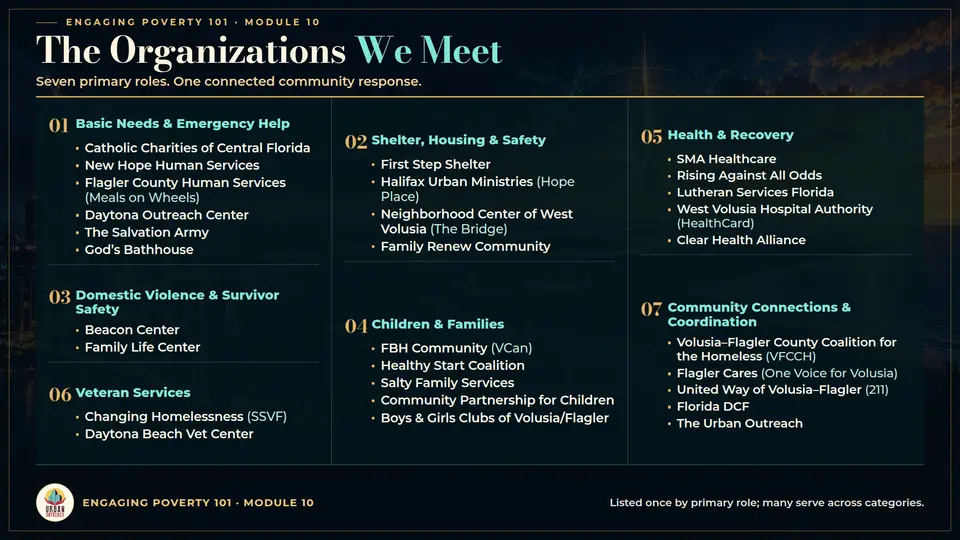
The organizations we meet
29 agencies in seven primary roles. Many serve across several roles; each is listed once.
Stars are signals, not verdicts. Ratings guide our questions; they don't replace a conversation. Research dated Sep 25, 2026; please confirm details with the agency before you refer, give or volunteer.
Basic Needs & Emergency Help
Basic-needs agencies address the practical gaps—food, clothing, hygiene, utilities, and transportation—that can quickly become a crisis.
-
Catholic Charities of Central Florida
4 of 4 stars 90% VolusiaA private nonprofit ministry of the Diocese of Orlando—not a government department, insurer or parish. Its Family Stability Program offers homelessness prevention, rapid rehousing, case management, and emergency rent and utility help for eligible clients. Approved clients may receive up to $1,000 for rent and/or $500 for utilities.
Serves: Eligible households in nine Central Florida counties, including Volusia.
Flagler is not on the published Family Stability county list; a Flagler office was not verified.
Give: Give through the official support page; ask whether the local program currently has funding.
Volunteer: Ask about current volunteer roles and offer skills that match local needs.
History, finances and rating notes
Legal name: Catholic Charities of Central Florida, Inc.
Founded 1962. Began in 1962 as a Diocese of St. Augustine ministry. It grew from help for needy families and adoption into housing, health care, food, refugee and disaster-relief work.
Revenue $13.0M · Expenses $13.7M (FY ending 2025). Form 990, filed May 13, 2026. Regional parent totals, not Volusia office accounts. Expenses exceeded revenue by $613,366.
Charity Navigator: Applies to the regional organization, not a separate Volusia office.
Volusia Family Stability contact. Assistance depends on eligibility and available funds.
Last reviewed Sep 25, 2026 · may be out of date, please check
-
The Salvation Army (Daytona Beach & West Volusia)
Not rated VolusiaA faith-based movement whose Daytona Beach and West Volusia corps provide practical help such as food, rent and utility assistance, disaster response and family support. The Daytona Beach corps also lists addiction support, youth activities, a community breakfast and Pathway of Hope.
Serves: People facing poverty and emergencies in Volusia County.
A Bunnell/Flagler service unit appears on the national locator, but Flagler County's February 2025 directory says that office is closed. Flagler service is unverified.
Give: Ask the local team whether your gift will support this community and how it will be used.
Volunteer: Start with the local giving or volunteer contact and confirm current priorities.
History, finances and rating notes
Founded 1865. The movement began as the Christian Mission in 1865 under William and Catherine Booth. Local founding dates were not established.
Charity Navigator: Not rated. The territorial record reviewed was not rated; that is not a negative judgment of local services.
Daytona Beach Corps: 1555 LPGA Blvd, Daytona Beach; Social Services: 340 North St, Daytona Beach; West Volusia Corps: 1240 S High St, DeLandLast reviewed Sep 25, 2026 · may be out of date, please check
-
New Hope Human Services
Not rated VolusiaOffers Hands of Hope food, hygiene and cleaning supplies, rent and utility help, and a monthly food pantry. It also runs youth programs, mentoring, the Dance Project, and E-3 educational and enrichment support.
Serves: Deltona and West Volusia residents, including young people.
Published needs
- Volunteers, including certified teachers for E-3 academic support
Give: Ask which pantry supplies would make the greatest difference now.
Volunteer: Ask about current volunteer roles and skills needed.
History, finances and rating notes
Legal name: New Hope Human Services, Inc.
Founded 1998. New Hope Church was established in 1993; the human-services nonprofit says it was established in 1998 to serve West Volusia.
Revenue $68K · Expenses $78K (FY ending 2025). Form 990-EZ, filed June 2, 2026. Expenses exceeded revenue by $9,521. For a small agency, that gap deserves a conversation; it does not by itself establish financial distress.
Charity Navigator: No current star rating verified.
386-532-8291 2855 Lake Helen-Osteen Road, DeltonaLast reviewed Sep 25, 2026 · may be out of date, please check
-
God's Bathhouse
Not rated VolusiaA mobile shower ministry that brings a private place to wash, hygiene essentials and clean clothing to people where they are. It partners with churches; listed host sites include First United Methodist Church in New Smyrna Beach and First Presbyterian Church in DeLand.
Serves: People experiencing homelessness in Volusia County.
Published needs
- Replacing its shower truck (confirm the need is still active)
- Clothing
- Toiletries
- Dependable volunteers
Give: Ask how gifts would support the vehicle or ongoing operations.
Volunteer: Check the current schedule and needs first.
History, finances and rating notes
Founded 2015. An independent nonprofit founded in 2015 that partners with churches to provide mobile showers.
Form 990-PF. A public filing exists, but a reliable current revenue-and-expense pair was not established.
Charity Navigator: No current standalone rating verified.
Last reviewed Nov 10, 2026 · may be out of date, please check
-
VCan
a program of FBH Community (formerly branded Food Brings Hope)
4 of 4 stars 95% VolusiaVolusia County Can Be Child/Youth Hunger and Homeless Free. A 24/7 call-or-text helpline connects families to short-term help in a crisis: emergency food boxes, basic supplies and shelter support, including a temporary hotel stay. Food delivery is currently unavailable in West Volusia, New Smyrna and Edgewater.
Serves: Volusia families with children or young people under 25 facing an emergency.
Give: Ask whether a gift can be designated for VCan and how support is allocated.
Volunteer: Ask which delivery or volunteer needs are current.
History, finances and rating notes
Founded 2007. Food Brings Hope began in 2007 when founder Forough B. Hosseini saw that children facing hardship lacked weekend food. VCan grew from rising emergency calls and waiting lists.
Revenue $4.65M · Expenses $2.53M (FY ending 2025). FBH Community Form 990, filed November 22, 2025. Parent totals, not VCan funding; expenses are a summary figure (about $2.5 million). The $1.761 million program revenue is Homes Bring Hope home sales, not profit or VCan funding.
Charity Navigator: Rating belongs to parent FBH Community, not a separate evaluation of VCan.
386-999-1888 is the VCan helpline. FBH Community volunteer and general line: 386-317-5767. Confirm eligibility before making a referral.
Last reviewed Sep 25, 2026 · may be out of date, please check
-
Flagler County Human Services
a division of Flagler County Health and Human Services
Not rated FlaglerA county-government division, not a nonprofit. It helps eligible low-income residents with past-due rent and utilities, certain first-month rent, mortgage assistance, and medical, prescription and emergency dental costs. The wider department includes Senior Services, Adult Day Care, Housing Services/SHIP and Meals on Wheels.
Serves: Eligible low-income Flagler County residents.
Published needs
- Volunteer and substitute Meals on Wheels drivers for Flagler routes (usually Tuesday mornings, about 1.5 hours; no mileage reimbursement)
Volunteer: Call 386-586-2324 ext. 3622 about Meals on Wheels driving.
History, finances and rating notes
Flagler County was incorporated in 1917. A founding date for the Human Services division was not established.
Flagler County FY 2024–25 adopted budget. Form 990 does not apply. The adopted Human Services appropriation was $5,931,300, a budget rather than audited actual spending.
Charity Navigator: Not applicable: county government.
Volunteer: ext. 3622. Human Services program manager: ext. 3629.
Last reviewed Sep 25, 2026 · may be out of date, please check
Shelter, Housing & Safety
Housing work is more than a bed for the night. It can involve preventing homelessness, providing shelter, or helping someone move into a permanent home.
-
First Step Shelter
4 of 4 stars 98% VolusiaAn emergency and transitional shelter that pairs a bed with intensive case management and a personal housing plan. Residents receive three meals a day, health screening, help with jobs and benefits, life-skills classes, transportation and housing navigation.
Serves: Single adults 18 and older experiencing homelessness in Volusia County.
Published needs
- Monetary and recurring gifts
- In-kind gifts (confirm current needs)
- Volunteer time
Give: Monetary, recurring, legacy or tribute gifts; ask which gifts best support the move into housing.
Volunteer: Ask which volunteer roles best support the move from shelter into housing.
History, finances and rating notes
Legal name: First Step Shelter, Inc.
Founded 2019. Opened in December 2019 in Daytona Beach. A shelter official described capacity for 100 beds (60 men, 40 women) in 2025.
Revenue $2.01M · Expenses $1.78M (FY ending 2025). Form 990, filed May 26, 2026. A positive annual result, not a guarantee of available cash.
In-kind needs: ext. 202 or psmith@firststepshelter.org.
Last reviewed Sep 25, 2026 · may be out of date, please check
-
Halifax Urban Ministries (HUM)
4 of 4 stars 95% VolusiaFlaglerA faith-based, non-sectarian nonprofit working across food assistance, homelessness prevention, shelter and housing. Programs include Feed-a-Family groceries and rent/utility help, Bridge of Hope hot meals, Hope Place, Barracks of Hope veteran housing, Pathways to Housing and Cars Bring Hope. In 2025 it reports 30,256 food bags, 261 households helped with rent or utilities, and 167+ households newly housed or case-managed.
Serves: People who are homeless or at risk of homelessness.
Listed food sites are in Volusia; Flagler service sites were not verified.
Published needs
- Financial donations (its greatest need)
- Nonperishable food
- Periodic volunteers
- Business and trade skills
Give: Direct gifts to general operations, Feed-a-Family, meals, family shelter/rehousing or direct services.
Volunteer: Volunteer or offer practical trade skills matched to a confirmed need.
History, finances and rating notes
Founded 1981. Founded in 1981 when local church and synagogue leaders joined to address economic hardship, first by feeding people in parks. It has grown from a $27,000 budget to a stated $3.4 million.
Revenue $4.49M · Expenses $4.54M (FY ending 2024). Form 990, filed September 9, 2025. Expenses exceeded revenue by about $49,500, a historical gap that calls for context, not a conclusion.
Charity Navigator: The completed assessment is Accountability & Finance; HUM-wide, not per program.
An earlier profile lists 386-317-5872.
Last reviewed Sep 25, 2026 · may be out of date, please check
-
Hope Place
a program of Halifax Urban Ministries
Not rated VolusiaHUM's family shelter and rehousing program: up to 90 days of emergency housing with support toward a permanent home. It has 26 emergency rooms and nine transitional apartments for families, plus dorm space for up to 24 young adults. Support can include meals, child care, tutoring, life skills and case management.
Serves: Families with children and young adults leaving foster care; admission is by agency referral and intake screening, not walk-up.
Give: Ask about program-specific needs and how designated gifts are tracked.
Volunteer: Ask HUM about available volunteer roles.
History, finances and rating notes
Founded 2017. Opened in 2017 (Module 9 materials give 2018). In 2025 HUM says Hope Place served 124 families and 71% moved to permanent housing.
No separate financial return; see Halifax Urban Ministries' organization-wide figures.
Charity Navigator: No separate rating. The 95%, four-star rating belongs to parent HUM; don't count parent and program as two endorsements.
Last reviewed Oct 1, 2026 · may be out of date, please check
-
Neighborhood Center of West Volusia
4 of 4 stars 95% VolusiaA DeLand-area nonprofit whose mission is to feed hungry people, house homeless people and prevent homelessness. It runs a food pantry, rent and utility help, transitional and permanent housing with case management, employment support, and a thrift store with client vouchers. Its 2025 report cites 200+ people housed daily in 64 units and 42,000+ prevention services.
Serves: Hungry, homeless and at-risk neighbors in West Volusia.
Published needs
- Nonperishable food, especially pop-top cans
- Diapers and pull-ups
- Travel-size hygiene items, toothpaste and toothbrushes
- Twin bedding and towels
- Razors and single pop-up tents
- Gift cards and clothing
- Meal service at The Bridge
Give: Recurring, one-time or planned gifts, or event sponsorship; say if you intend to support a specific program.
Volunteer: Serve meals at The Bridge, help at events, or offer practical skills.
History, finances and rating notes
Founded 1969. Founded in 1969 in an old house on Woodland Boulevard in DeLand. It also operates The Bridge shelter, which opened in 2020.
Revenue $3.93M · Expenses $3.66M (FY ending 2025). Form 990, filed July 23, 2026. Organization-wide totals, not The Bridge's budget or cash available for each program.
Charity Navigator: For the organization as a whole.
Last reviewed Sep 25, 2026 · may be out of date, please check
-
The Bridge
operated by Neighborhood Center of West Volusia
Not rated VolusiaA 30-bed shelter and day center in DeLand, owned and funded by the City of DeLand. It provides lodging, meals, showers, laundry, lockers, case management, and links to housing, benefits and employment.
Serves: Adults experiencing homelessness in the DeLand area.
Published needs
- Meal volunteers
- Toiletries
Volunteer: Prepare or serve meals.
History, finances and rating notes
Founded 2020. Grew from a 2016 collaboration among the Neighborhood Center, Volusia County, West Volusia cities, churches, businesses and civic groups; opened in September 2020.
No separate statement. Before a substantial commitment, ask for the current program budget and how the City and operator share responsibilities.
Charity Navigator: No separate rating; operator Neighborhood Center of West Volusia is rated 95%, four stars.
Last reviewed Sep 25, 2026 · may be out of date, please check
-
Family Renew Community
3 of 4 stars 83% VolusiaProvides furnished, rent-free transitional apartments and case management. Parents work toward employment, savings and stable housing, and families may stay six months or longer. It has 40 apartments across campuses in DeLand, Holly Hill, Daytona Beach and Edgewater.
Serves: Families with children experiencing homelessness in Volusia County.
Published needs
- Household goods
- Personal care items
- Nonperishable food
Give: Donate requested goods; ask how operations are funded now.
Volunteer: Volunteer at the Secret Attic thrift shop.
History, finances and rating notes
Founded 1989. Says it began in 1989 with 20 religious organizations. It supports about 60 families a year; a January 2026 report cited about 100 families on the waitlist.
Revenue $1.43M · Expenses $1.45M . Form 990, 2024 reporting year. A one-year shortfall of $23,574; one year alone does not establish its current condition.
Charity Navigator: Look at the completed assessment and ask where improvement is needed.
Website ↗ DeLand: 259 W. Voorhis Ave.; Holly Hill: 810 Ridgewood Ave.; Daytona Beach: 105 South St.Last reviewed Nov 10, 2026 · may be out of date, please check
-
Volusia County Community Assistance
a division of Volusia County government
Not rated VolusiaA county-government division that administers affordable-housing assistance, Housing Choice Vouchers, grants planning and monitoring, and temporary emergency human services. Volusia Helps directs residents and providers to services.
Serves: Eligible Volusia County residents.
Volunteer: Share accurate information through Volusia Helps, follow public plans, or explore advisory-board opportunities.
History, finances and rating notes
Volusia County was created in 1854 and has had a Home Rule Charter since 1971. The division's start date was not established.
Volusia County ACFR and draft FY2025 Action Plan. Form 990 does not apply, and no division-only budget was located. Planned FY2025 federal allocations of about $2.54 million are planning amounts, not spending; the county's entire budget is not homelessness spending.
Charity Navigator: Not applicable: county government. Look at program budgets, spending reports, eligibility rules and results instead.
Check the current application process and program openings before directing someone here.
Last reviewed Sep 25, 2026 · may be out of date, please check
Domestic Violence & Survivor Safety
For someone experiencing domestic or sexual violence, safety changes everything. Confidentiality, careful planning and survivor choice are central to this work.
-
Beacon Center
4 of 4 stars 90% VolusiaFree, confidential support for domestic-violence survivors and their children: secure emergency shelter, a 24-hour hotline, crisis counseling, advocacy, safety planning and support groups. It also helps with court injunctions, transportation, victim compensation and economic-justice advocacy.
Serves: Domestic-violence survivors and their children in Volusia County.
Reviewed sources do not establish Flagler coverage. The shelter location is confidential.
Published needs
- Twin sheets and blankets
- New pillows and towels
- Cleaning and paper products
- Personal-care items
- Food
- Gift and gas cards, bus passes
- Infant and child supplies
- Over-the-counter and first-aid goods
- Hurricane supplies
Give: Cash gifts or requested items; call for drop-off information.
History, finances and rating notes
Legal name: Domestic Abuse Council of Volusia County, Inc.
Founded 1976. Formed in 1976, according to a public nonprofit profile. Recent work added trauma-informed case management, child and youth prevention, and a 2026 pet-safety housing partnership.
Revenue $1.84M · Expenses $1.71M (FY ending 2025). Form 990, filed August 14, 2026. A positive annual balance, not proof of current unrestricted reserves.
Charity Navigator: For the Domestic Abuse Council, the legal organization behind Beacon Center; covers Accountability & Finance.
Donation drop-off information.
Last reviewed Sep 25, 2026 · may be out of date, please check
-
Family Life Center
3 of 4 stars 76% FlaglerVolusiaNo-cost, survivor-directed help for people affected by domestic or sexual violence: crisis lines, safe-house access, safety planning, counseling, and legal, court and medical advocacy. Florida identifies it as a certified domestic-violence shelter and rape-crisis center.
Serves: Survivors of domestic or sexual violence in Flagler and Volusia counties.
Published needs
- Tax-deductible and planned gifts
- New items (confirm what is accepted)
- Shelter, administrative and outreach volunteers
- On-call sexual-assault advocates
- Donation sorting
- Board or committee expertise in marketing, construction, legal and accounting
Give: Financial gifts or accepted new items.
Volunteer: Advocacy, donation sorting or committee work after required screening and training; some roles need Level 2 screening.
History, finances and rating notes
Legal name: Flagler Ecumenical Social Service Center, Inc.
Founded 1987. Founded in 1987 by Dr. John McNeely and six faith communities. It became a certified domestic-violence center in 2002 and a rape-crisis center in 2015.
Revenue $2.20M · Expenses $2.25M (FY ending 2025). Form 990, filed January 29, 2026. Expenses exceeded revenue by about $53,000; ask whether that gap has been addressed.
Charity Navigator: For the organization's legal entity.
Last reviewed Sep 25, 2026 · may be out of date, please check
Children & Families
Support for children and families can begin during pregnancy and continue through the teenage years. It includes infant health, stronger parenting, family-crisis prevention, foster care and mentoring.
-
Healthy Start Coalition of Flagler & Volusia Counties
4 of 4 stars 91% FlaglerVolusiaConnects families to screening, home visiting, care coordination and parent resources. Free services include Healthy Start education, Healthy Families home visiting, nurse home visiting for high-risk families, doula services, TEAM Dad and bereavement support. It is not an insurer, government department, shelter or church.
Serves: Pregnant women, expectant and new parents, infants, and families with children under three.
Give: Donations; ask how current funding supports families.
Volunteer: Offer requested skills or make appropriate referrals.
History, finances and rating notes
Legal name: The Healthy Start Coalition of Flagler & Volusia Counties, Inc.
Founded 1991. Grew out of Florida's 1991 Healthy Start Initiative, which created 32 local coalitions focused on infant health and child development.
Revenue $3.62M · Expenses $3.77M (FY ending 2025). Form 990, filed May 15, 2026. Expenses exceeded revenue by $152,404; that alone does not mean services are at risk. Ask whether it was a planned use of resources.
Charity Navigator: For the two-county organization.
Connect referrals: 386-238-9347.
Last reviewed Sep 25, 2026 · may be out of date, please check
-
Salty Family Services
a ministry of Salty Church (Salty Ministries, Inc.)
Not ratedHelps families in crisis through immediate practical assistance and sustained mentoring. Its aim is to strengthen families and help prevent abuse, neglect and separation.
Serves: Families in crisis.
Reviewed sources do not state its service area.
Published needs
- Volunteers to serve at the Rescue Station
- “Call Me When” helpers who can offer a ride, a meal, tutoring or car repair
Give: Ask how gifts reach this ministry and how outcomes are followed.
Volunteer: Serve alongside staff at the Rescue Station, or join “Call Me When” and offer a skill when a family needs it.
History, finances and rating notes
Founded 2016. Formed in 2016 as a Salty Church ministry. Nine team members were named; a paid staff count was not verified.
No public financial statement, audit or Form 990 was located. Church-related ministries may not have the same filing requirements; that is a reason to ask, not to assume a problem.
Charity Navigator: No separate rating; the parent Salty Ministries record reviewed did not display stars.
Last reviewed Nov 10, 2026 · may be out of date, please check
-
Community Partnership for Children
2 of 4 stars 67% VolusiaFlaglerThe community-based-care lead agency that coordinates child-welfare services with Florida DCF and a provider network. Its work includes case management, safety planning, foster care, adoption, family-stability services and mentoring.
Serves: Children and families in Volusia, Flagler and Putnam counties.
Also serves Putnam County; financial figures cover all three counties.
Published needs
- Foster parents (age 21+, with screening, training and a home study)
- Volunteer mentors for youth ages 14–17 (at least one hour weekly for three months)
- Case management interns
Give: For a substantial commitment, ask for current financial reports and results.
Volunteer: Become a screened mentor or a licensed foster parent.
History, finances and rating notes
Legal name: Community Partnership for Children, Inc.
Founded 2001. Lead agency since 2001, following Florida's community-based-care reform. Formerly Community Based Care of Volusia and Flagler.
Revenue $64.2M · Expenses $64.3M (FY ending 2025). Form 990, filed March 26, 2026. Three-county entity totals, with a $32,943 deficit.
Charity Navigator: Ask which measures lowered the score and what improvements are underway; a lower score does not prove misconduct.
Last reviewed Sep 25, 2026 · may be out of date, please check
-
Boys & Girls Clubs of Volusia/Flagler Counties
4 of 4 stars 94% VolusiaFlaglerSafe after-school places with caring adults, mentoring, academic enrichment, leadership, arts, sports and workforce-readiness activities. This is the local Clubs organization, not the national one.
Serves: Young people in Volusia and Flagler counties.
Published needs
- School and art supplies
- Backpacks
- Gift cards for teens
Give: Requested supplies, or support a local event or sponsorship.
Volunteer: Mentor, tutor, coach or help at events; confirm screening first.
History, finances and rating notes
Founded 1992. Incorporated in 1992.
Revenue $2.86M · Expenses $3.23M . Form 990, fiscal 2024. Rounded figures; a gap of roughly $366,000. Before a major gift, ask whether it was planned and whether recurring funding has improved.
Charity Navigator: Local Clubs organization, not the national organization.
Last reviewed Nov 10, 2026 · may be out of date, please check
Health & Recovery
Health and recovery are closely tied to whether someone can keep working, care for family, and remain housed. As we look at each one, ask what barrier it helps a person overcome.
-
SMA Healthcare
4 of 4 stars 100% VolusiaFlaglerAn independent nonprofit behavioral-health provider, not a government agency, offering crisis, residential and outpatient care for mental-health and substance-use needs. It also provides prevention, walk-in screening, justice services and primary care; services vary by site.
Serves: People with mental-health and substance-use needs, through sites in Volusia and Flagler.
Give: Through the separate SMA Healthcare Foundation; ask how a gift reaches your intended program.
Volunteer: Volunteer or internship, depending on qualifications, screening and current openings.
History, finances and rating notes
Legal name: SMA Healthcare, Inc.
Founded 1961. Its predecessor began in 1961. Stewart-Marchman Center merged with ACT in 2008, became SMA Healthcare in 2018, and merged with The Centers in 2021.
Revenue $104.6M · Expenses $96.0M (FY ending 2025). Form 990, filed April 14, 2026. Provider-wide totals; services and funding vary by location. The SMA Healthcare Foundation is a separate fundraising organization.
Charity Navigator: Operating provider; covers Accountability & Finance, not every clinical outcome.
Volunteer/internship line. 24/7 helpline: 800-539-4228.
Last reviewed Sep 25, 2026 · may be out of date, please check
-
Rising Against All Odds
4 of 4 stars 90% VolusiaConfidential HIV, STI and hepatitis C testing through office, mobile and in-home visits, plus prevention education, PrEP/PEP navigation and treatment-adherence support. It also helps low-income West Volusia residents apply for the West Volusia Hospital Authority Health Card and other benefits.
Serves: West Volusia residents.
Flagler operations were not verified.
Published needs
- Recurring gifts
- Hygiene items
- Professional clothing for workforce re-entry
- Household goods for Healthy Housing (dishes, linens, tables, chairs, mattresses)
- Office supplies
- Food-pantry items and gift cards
Give: Recurring gifts or requested supplies.
Volunteer: Volunteers are matched to community work by skill, without compromising anyone's privacy.
History, finances and rating notes
Legal name: Rising Against All Odds, Inc.
Founded 2011. Founded in 2011 by Brenda Flowers-Dalley as a grassroots West Volusia health and prevention organization.
Revenue $889K (FY ending 2025). Form 990, filed March 3, 2026. A reliable FY2025 expense total was not available, so no surplus should be inferred.
Last reviewed Sep 25, 2026 · may be out of date, please check
-
Clear Health Alliance
Not ratedA Florida Medicaid specialty health plan for people living with HIV or AIDS that coordinates covered care through contracted providers. It is a for-profit plan through Simply Healthcare, not a charity, shelter or clinic. Our role is more likely an accurate referral than a donation.
Serves: Eligible Florida Medicaid members living with HIV or AIDS.
Statewide plan; confirm Volusia and Flagler provider availability with the plan.
History, finances and rating notes
Legal name: Simply Healthcare Plans, Inc.
Simply Healthcare was established in Florida in 2010 and says it was first to offer a Medicaid specialty plan for people living with HIV/AIDS. By 2013 the plan had expanded beyond Miami-Dade.
Florida Office of Insurance Regulation examination. A for-profit HMO under state regulatory oversight; Form 990 does not apply.
Charity Navigator: Not applicable: for-profit health plan.
Last reviewed Sep 25, 2026 · may be out of date, please check
-
Lutheran Services Florida (LSF)
3 of 4 stars 76% VolusiaFlaglerA statewide nonprofit that runs Family Focus, Head Start and Health Systems programs. LSF Health Systems is the behavioral-health managing entity under contract with Florida DCF, coordinating care through contracted providers. That coordinating role does not itself make it a shelter or clinic.
Serves: Uninsured or underinsured people facing poverty and mental-health or substance-use needs, in a 23-county network.
Published needs
- Reading with children
- Mentoring
- Sorting donations
Give: One-time gifts or Circle of Hope; ask how support reaches the intended local service.
Volunteer: Local openings vary; confirm through the volunteer page.
History, finances and rating notes
Founded 1982. Began in 1982 to sustain Lutheran church work responding to Vietnamese and Cuban refugee crises. It took on behavioral-health managing-entity work in 2012.
Revenue $443.7M · Expenses $439.8M (FY ending 2025). Form 990, signed April 23, 2026. Statewide totals, not a Volusia–Flagler program budget.
Charity Navigator: For the statewide parent organization, not a local program.
LSF Health Systems behavioral-health access line.
Last reviewed Sep 25, 2026 · may be out of date, please check
-
Daytona Outreach Center
Not rated VolusiaA Christian, faith-based ministry offering showers, clean clothes, referrals, counseling and other daytime help to people without a home. It runs a separate residential, faith-based recovery program for men called the 28:20 Project. It is not documented as a walk-in shelter.
Serves: People experiencing homelessness in the Daytona Beach area, and men accepted into its residential program.
Flagler reach was not verified.
Published needs
- Volunteers and donations (no specific items published)
Give: Ask about current funding, how resources are used and what results they can show.
Volunteer: Understand the screening process and faith expectations first, and confirm what help is actually needed.
History, finances and rating notes
Legal name: Daytona Outreach Center, Inc.
Founded 2007. Founded by Ray and Susan Kelley, who once housed men in their own home; incorporated in 2007. By 2021 its North Street site was reported to provide nearly 40 showers a day.
Revenue $213K · Expenses $216K (FY ending 2024). Form 990, filed November 10, 2025. A relatively small one-year gap of $2,441.
Charity Navigator: No current rating verified; no rating is not a negative finding.
Mail: PO Box 1925, Daytona Beach, FL 32115.
Last reviewed Sep 25, 2026 · may be out of date, please check
Veteran Services
Veterans and their families may need housing help, counseling, benefits assistance or a stronger connection to their community. These services are not interchangeable, and eligibility varies.
-
Changing Homelessness — SSVF
2 of 4 stars 70% VolusiaFlaglerProvides VA-funded Supportive Services for Veteran Families (SSVF) to help eligible veteran families prevent or leave homelessness. The work includes housing search, rapid rehousing, budgeting and benefits connections.
Serves: Low-income veteran families who are homeless or at imminent risk.
Confirm current Volusia–Flagler coverage before giving or volunteering.
Give: Confirm how your support would benefit veterans in this community.
Volunteer: Confirm current opportunities with the organization.
History, finances and rating notes
Legal name: Changing Homelessness, Inc.
Founded 1974. A Jacksonville-based organization whose community work began in 1974. SSVF expanded to Palm Coast in 2018, and the local project reported 117 households assisted in 2023.
Revenue $17.9M (FY ending 2024). Form 990, filed November 13, 2025. Approximate revenue from three reported components; no reliable total-expense figure. Organization-wide, not a local SSVF budget.
Charity Navigator: For the parent organization, not a separate score for the local SSVF program.
Veterans needing immediate help: VA National Call Center, 877-424-3838.
Last reviewed Sep 25, 2026 · may be out of date, please check
-
Daytona Beach Vet Center
a site of the VA's Readjustment Counseling Service
Not rated VolusiaA federal program offering confidential, no-cost individual, family, couples and group counseling. Support covers PTSD, depression, grief, trauma, military sexual trauma and transition, plus referrals for substance use, benefits, employment and medical screening.
Serves: Eligible veterans, active-duty service members (including National Guard and Reserve) and their families.
Located in Daytona Beach; the official page does not define a county catchment.
Published needs
- Community partnerships
Volunteer: Ask about a community partnership or share veteran-resource information.
History, finances and rating notes
Founded 1979. Congress established the Vet Center program in 1979. In FY2025 the Daytona Beach site reported 375 unique clients and six staff.
Federal program; Form 990 does not apply and no site budget is published.
Charity Navigator: Not applicable: federal program.
24/7 Vet Center call center: 877-927-8387.
Last reviewed Sep 25, 2026 · may be out of date, please check
Community Connections & Coordination
No single organization can meet every need, and a referral matters only if it leads someone to useful help. These agencies bring together resources, information, funding, and community partners.
-
Volusia/Flagler County Coalition for the Homeless (VFCCH)
4 of 4 stars 95% VolusiaFlaglerCoordinates the regional response to homelessness through partnerships, referrals, shared data, grants and pathways to housing. It administers the Homeless Management Information System, while a separate commission governs the regional Continuum of Care.
Serves: Partner agencies and people experiencing homelessness across Volusia and Flagler counties.
Volunteer: Point-in-Time Count volunteering and donation drives.
History, finances and rating notes
Founded 2000. Incorporated in 2000 as the administrative lead for the two-county homelessness response. A separate regional Continuum of Care was created in 2014.
Covered in Module 9. Earlier course narration noted its 2025 audit reported a significant internal-control deficiency; for a major gift, ask what corrective steps have been completed.
Charity Navigator: For VFCCH as an organization, not the entire regional partnership.
Last reviewed Nov 10, 2026 · may be out of date, please check
-
Flagler Cares
3 of 4 stars 88% FlaglerVolusiaA safety-net and care-navigation nonprofit. Its No Wrong Door work helps people identify needs, navigate benefits and health insurance, get screenings and referrals, and access counseling. Programs include CORe opioid-recovery support, ID and disability help, Marketplace navigation and Flagler County Village.
Serves: Flagler County residents and, since its 2024 merger with One Voice for Volusia, Volusia residents.
Published needs
- Donations
- Coalition participation
- Organizational participation in the LINC referral network
Give: Donations.
Volunteer: Volunteer roles are listed as coming soon; join coalition meetings.
History, finances and rating notes
Legal name: Flagler Cares Inc.
Founded 2015. Began as an informal coalition in 2013, incorporated in 2015 and started direct client services in 2018. Merged with One Voice for Volusia in July 2024.
Revenue $2.76M · Expenses $2.31M (FY ending 2025). Form 990, filed December 1, 2025. Entity-wide totals. Program funding can still change: the Volusia Cares RISE rent/mortgage program closed when its funding ended.
Charity Navigator: For the local organization.
Verify a program is still available before referring someone.
Last reviewed Sep 25, 2026 · may be out of date, please check
-
United Way of Volusia-Flagler Counties
4 of 4 stars 95% VolusiaFlaglerConnects people with help through 211, supports community partners, and links donors and volunteers with local needs. Dialing 2-1-1 reaches a specialist who helps identify local resources—a doorway into the network, not a guarantee of assistance.
Serves: Residents, donors and volunteers across Volusia and Flagler counties.
Published needs
- Community Impact Cabinet grant reviewers
- AARP Foundation Tax-Aide volunteers (free tax preparation)
- Generation IMPACT members to mentor student-led projects
- Women United advocates
Give: Ask whether a gift supports a named fund, a partner or broader community work, and how results are reported.
Volunteer: Volunteer, or share accurate information about 211.
History, finances and rating notes
Founded 1996. The local United Ways merged in 1996.
Revenue $4.71M · Expenses $3.33M (FY ending 2025). Audited financial statements, FY2025. Rounded totals; net assets rose by $1.38 million. Donor restrictions can affect how money is used.
Charity Navigator: For the local organization, not national United Way.
Last reviewed Nov 10, 2026 · may be out of date, please check
Questions to ask before you give
How to read the ratings
- Stars are signals, not verdicts. Four stars is not a guarantee; two or three stars mean we need more information.
- Unrated is different from zero stars. Government offices and for-profit health plans are different comparisons altogether.
- A score of 90% does not mean 90 cents of every donated dollar goes to programs. It is an evaluation score, not a breakdown of how donations are spent.
- A past deficit does not automatically mean trouble, and a surplus does not tell us how much unrestricted cash is available.
- Organization-wide totals are not a local-office or individual-program budget.
- These ratings guide our questions; they do not replace a conversation.
- Research dated September–November 2026. Services, contacts, eligibility, finances and ratings may change; verify directly before referring, giving or volunteering.
- This training is education, not an endorsement of any agency or a guarantee of assistance.
Go deeper
Read the full transcript
Deciding whom to support—and how—when people are living in poverty can feel as complex as figuring out proper nutrition in an ever-changing field. But if you have been through Modules 1–9, you know it matters because we all have a role to play. We need to give more, and give thoughtfully, to places that need and deserve support. But where? And to whom? That is what this module is about. But first, rather than a quick review of past modules, I want to share how I found my place in this work—and why I believe this information is worth considering, since many of you may still be wondering about your next step or wondering about the credibility of the person leading you through these modules.
My name is Tom Wheeler.
I have authored eight books, am an entrepreneur, and a former pilot, EMT, and pastor. I’ve also completed multiple Ironman triathlons. I co-founded Hoskins Park Ministries with a man who had experienced homelessness, and for six years I lived alongside men coming off the street.
Here is the short version of my story.
As a new Christian in 1993, I became troubled when I passed people experiencing homelessness on the street. I started stopping my car to speak with them. Being a fairly direct communicator, I gave them a couple of dollars and then asked why they were homeless. They answered. One told me he had a nervous breakdown. Another told me his wife had an affair and left him – which sent him spiraling down the drain. A couple I spoke to said he had and his wife had both gotten ill, lost their jobs, insurance denied their claims, and eventually they lost their house. There were different circumstances, decisions, and barriers to getting off the street. When I asked why they weren’t staying in a shelter, some described theft and violence. They did not feel safe there. That made me curious, but who was I to disagree? Or maybe they were just telling me a story to get money. Who knew? I didn’t.
At the same time, I began asking people I knew, even people in church, what they thought when they passed someone holding a sign. Some were compassionate. But many said those people were drug addicts or criminals, reaping what they had sown. Their circumstances were their own fault, they said, so there was little reason to be troubled.
Then came the big question: “You didn’t give them any money—did YOU?” they asked, cocking their heads. Honestly, nearly everyone I asked believed giving them money would only enable them.
And, they added, the stories I had heard were indeed lies meant to con me out of my money. Bottom line: stay away.
But I wasn’t convinced that either perspective gave me the whole picture. As for the money, I thought about my own life. I had worked for Apple Computer in the 1980s, earned enough to own an airplane in my 20s, and spent weekends drinking my sorrows away. I figured I had wasted far more money than the people I met on the street. To me, giving them a few dollars seemed better than simply ignoring them or doing nothing. I mean, what if—God forbid—it were me?
Still, I didn’t know how to find out the truth. I was also wrestling with my own purpose. I had followed the world’s path long enough to know it would never satisfy me. But what was I supposed to do when even the question of whether to help seemed so controversial?
I would live as a homeless man for a few days. That was my answer.
I checked into the local men’s shelter in Charlotte, North Carolina, as a homeless person at the end of October, 2002. Once inside, I made it my purpose to inspire the men to get their act together so they could move on from such a hard place in life. I acted like a platoon leader trying to get his men in shape to handle life the way I did—even though my own life had not worked out the way I expected. Still, it was better than theirs, right? That meant I judged each man by my life story without knowing his.
I believed people should take responsibility for their lives, and I still do. But I was measuring the men in that shelter against my own story before I knew theirs. I was a new Christian; learning not to make that leap was harder than agreeing with the verse.
That led to several confrontations, and I was forced to listen as the men shouted their stories at me because my approach was not working. Some had health issues that caused job loss and bankruptcy. Another had been shot five times during an argument and had miraculously survived.
But he didn’t have insurance and his recovery left him bankrupt and homeless.
Another told me his father had thrown him out of the window of a moving car when he was three, crippling the arm he held up to show me. These were not excuses or stories invented to get money – these were their painful realities. Most of the men were nothing like the labels I had heard. I began to see people, not a category.
I do not have time to share all of the experiences from those four days, but one more is worth sharing because it showed me how easily we can keep people experiencing homelessness at a distance—even while trying to help them. I wanted to go to church on the Sunday of my short stint, so I joined the men on a bus that took us to a large church in the area. Once there, we were escorted to a separate seating area. We were not allowed to choose where we sat, and we were supervised throughout the visit. We had been brought to church, but we were still being treated as a separate group and eyes were on us. I could feel them. And it was an African American church. That is when I began to understand. The tendency to judge or distance ourselves from people experiencing homelessness is not confined to any one racial group. This is a human issue. People of every background can see a label before they see a person—including me. And it hurt.
That experience set me on a path that eventually led me to move into an impoverished neighborhood in Charlotte, North Carolina, work as a supervisor in that same shelter, and then cofound Hoskins Park Ministries with a formerly homeless man, Johnny Allen. I lived with men coming off the street for the next six years. In the decades that followed, relationships, mistakes, and experience taught me how important it is to understand poverty before trying to fix it. In fact, I came to believe that one of the most useful things I could do was help prepare others for this work—to share what I wish I had understood before I began. Like me when I started, most people trying to help do not understand how to do so, despite their best efforts. Sometimes we do the right thing the wrong way and hurt someone because “we just didn’t know,” which is worth another illustrative example.
Despite our objections, while I was executive director at Hoskins Park Ministries, someone bought $300 worth of tools for a participant because the participant told the compassionate man that not having those tools was the barrier between the streets and a home and the donor believed him. Our participant immediately sold the tools and used the money for drugs. He ended up back on the streets a day later. Sadly, that happens more often than not, even in our churches. If we want to help, we need to help the people already doing the work, which is why I created Engaging Poverty 101. Training should be a priority for anyone engaged in poverty work—or anyone who wants to be. If this is the first module you are watching, please make sure you watch the others modules, before assuming you have the proper knowledge to effectively help. They all matter. And, if you have watched all the modules, I will send email you a certificate of completion when you are done with Module 10. Just email me.
So, how do we move from a desire to help to a wise place to connect? We look at the local organizations already doing the work. I have grouped them by the services they provide. I will highlight what each one does, its listed Charity Navigator rating, relevant financial context, and practical ways to help.
Charity Navigator gives us a starting point for asking questions before we give. It assigns eligible charities a score from zero to 100, then displays that score as a rating from zero to four stars.
The assessment may cover finances and accountability, impact, leadership, and workplace practices. But not every charity has been evaluated in every area, so it is worth looking at what contributed to its score.
Four stars is the highest rating. It is a positive signal based on the information evaluated, but it does not guarantee that an organization is financially healthy today or that a particular local program is effective. If you see two or three stars, look at the details before deciding what the rating means.
And one distinction is especially important: a score of 90% does not mean 90 cents of every donated dollar goes to programs. It is an evaluation score, not a breakdown of how donations are spent.
Unrated is different from zero stars. Some smaller charities, churches, and programs do not have a standalone rating. Government offices and for-profit health plans are different comparisons altogether.
Financial records also need context. A past deficit does not automatically mean trouble, and a surplus does not tell us how much unrestricted cash is available. Look at the reporting year, cash reserves, funding commitments, and recent results. These ratings guide our questions; they do not replace a conversation.
We will begin with Basic Needs & Emergency Help, then move into Shelter, Housing & Safety. From there, we will consider Domestic Violence & Survivor Safety, Children & Families (including pregnancy and infant health), Health & Recovery, and Veteran Services. We will finish with Community Connections & Coordination: the organizations that help people navigate services and connect the community’s response.
Many agencies work across these categories. To avoid repeating the same profiles, we will introduce each agency or program once, under its primary role, while noting important connections to other services.
Finally, there’s one more area I believe we should examine when assessing a nonprofit agency: its board of directors. Does the agency have an active board? And if it does, what does that board actually do?
Does it review finances, set direction, evaluate the executive director, and have the authority to challenge decisions? Or does it simply approve whatever the director proposes? I also want to know whether any members understand poverty firsthand, either through their own experience or through sustained work alongside people facing it. Those are different kinds of knowledge, and both matter. A board should provide real oversight while keeping the agency connected to the people its decisions affect.
Charity Navigator’s Accountability & Finance assessment checks the board’s reported size and independence, whether the charity reports keeping board minutes, and whether it reports having a conflict-of-interest policy. But Charity Navigator does not review those minutes to determine whether the board actually challenges the executive director. Nor do those checks tell me whether board members understand poverty or whether potential conflicts are handled well in practice. The rating helps me ask, “Is there evidence of basic board structure and governance practices?” A direct conversation must answer, “Does this board exercise meaningful oversight, and whose experience informs its decisions?” If I find that a board, however compassionate, does not yet understand poverty, has little relevant experience, is still learning how to provide oversight, or leaves serious governance questions unresolved, I refrain from supporting the agency until those concerns are addressed. That includes potential conflicts of interest—such as an executive director who may personally benefit from a housing operation or when tenants live in substandard conditions.
Basic Needs & Emergency Help
Let’s get started. Our first agency in the Basic Needs & Emergency Help category is:
Catholic Charities of Central Florida or (CCCF). It is a private nonprofit ministry of the Diocese of Orlando—not a government department, insurer, or parish. Its Family Stability Program serves nine counties, including Volusia, and offers homelessness prevention, rapid rehousing, case management, and emergency rent and utility assistance for eligible clients. Approved clients may receive up to $1,000 for rent and/or $500 for utilities. CCCF also operates regional programs in food, housing, immigration and refugee services, behavioral health, disaster relief, and clinical care.
Flagler does not appear on the published Family Stability county list, so we have not verified a Flagler office or current service footprint. CCCF’s listed Charity Navigator rating is 90 percent and four stars—a strong result on the factors evaluated—but it applies to the regional organization, not a separate Volusia office. Given the parent organization’s reported $613,366 gap, the practical questions are whether the local program currently has funding and where our contribution would go.
Next is The Salvation Army
The Salvation Army’s Daytona Beach and West Volusia corps provide practical help such as food, rent and utility assistance, disaster response and family support. We did not verify a separate local Charity Navigator score. The territorial record reviewed was not rated, which should not be mistaken for a negative judgment about these local services. Because this is a large organization, the most useful financial question is local: will my gift support this community, and can the local team explain how it will be used? Begin with the local giving or volunteer contact and confirm current priorities.
New Hope Human Services combines food and hygiene assistance with rent and utility help, mentoring and youth programs in the Deltona area. No current Charity Navigator star rating was verified. Its financial filing gives us a useful question, however. In fiscal 2025, expenses of about $77,600 exceeded revenue of about $68,100. For a small agency, that gap deserves a conversation about current funding and available cash. It does not, by itself, establish financial distress. Ask whether the gap has been addressed and which pantry supplies, volunteer roles or skills would make the greatest difference now.
God’s Bathhouse offers something easy to overlook: a shower, clean clothing and a place to regain a little dignity. Its mobile work serves people experiencing homelessness in Volusia County. No current standalone Charity Navigator rating was verified, so we need to learn through the ministry’s own reporting and a direct conversation. Published information included a need connected with replacing its shower truck. Confirm whether that need is still active and how gifts would support the vehicle or ongoing operations. Clothing, toiletries and dependable volunteers may also help, but check the current schedule and needs first.
VCan, a.k.a, Volusia County Can Be Child/Youth Hunger and Homeless Free, connects Volusia families with children or young people under 25 to short-term help during a crisis. That can include food, basic necessities or emergency shelter support. The listed score is 95 percent and four stars for its parent organization, FBH Community—which was formerly branded Food Brings Hope, it is not a separate evaluation of VCan. That is a positive organizational signal, but we still need to understand this particular program. No VCan-only financial statement was located. Ask how support is allocated, whether a gift can be designated for VCan, and which delivery or volunteer needs are current. Confirm eligibility before making a referral.
It should be noted that the $1.761 million listed comes from Homes Bring Hope, another FBH Community initiative that builds or renovates homes and sells them to qualifying families. It represents home-sale revenue, not profit—and it should not be mistaken for VCan funding.
Flagler County Human Services is a county-government division within Health and Human Services, serving Flagler County—not a standalone nonprofit. It assists eligible low-income residents with past-due rent/utilities, certain first-month rent, mortgage assistance, medical/prescription/emergency dental assistance, and administers mandated health-care responsibilities, local matches, indigent cremation, and county grants to nonprofit agencies. The broader department includes Senior Services, Adult Day Care, and Housing Services/SHIP. The specific published volunteer request is through Senior Services: Meals on Wheels needs volunteer and substitute drivers for Flagler routes, typically a Tuesday-morning route averaging 1.5 hours, without mileage reimbursement. The Human Services page itself does not publish a supply list, donation campaign, shortfall, or fundraising goal.
Shelter, Housing & Safety
Our next Category is — Shelter, Housing & Safety
Housing work is more than a bed for the night. It can involve preventing homelessness, providing shelter, or helping someone move into a permanent home. These organizations serve different people and offer different pathways. Before referring someone or volunteering, we need to understand both the immediate help and the next step toward stability.
And our first agency is: First Step Shelter
First Step Shelter serves single adults experiencing homelessness in Volusia County, combining shelter with case management and help toward housing. Meals, transportation, employment assistance and health-related support can all be part of that pathway. Its listed Charity Navigator rating is 98 percent and four stars for the organization itself. That is a strong score, though housing outcomes still deserve attention. Its fiscal 2025 filing reported more revenue than expenses, a positive annual result rather than a guarantee of available cash. If you want to help, ask which current gifts or volunteer roles best support the move from shelter into housing. Its public Form 990 provides organization-wide finances, and the 2025 filing profile lists 32 employees. General contact is 386-361-3800.
Halifax Urban Ministries, or HUM, works across food assistance, homelessness prevention, shelter and housing support. Its listed rating is 95 percent and four stars. Importantly, the completed assessment is Accountability and Finance—one of Charity Navigator’s four areas—not a separate proof of every program’s impact. Its fiscal 2024 filing showed expenses exceeded revenue by about $49,500. That historical gap calls for context, not a conclusion that HUM is in trouble. Ask how current funding supports the work you want to help. Food donations, volunteering and practical trade skills can contribute when matched to a confirmed need.
Hope Place is Halifax Urban Ministries family shelter program that opened in 2017. It serves eligible families with children and young adults leaving foster care, with up to 90 days of family emergency housing and support toward permanent housing. Hope Place has no separate return or verified site staff count; HUM reported 52 employees in 2024. In 2025, HUM says 71 percent of Hope Place families moved to permanent housing. Support can include meals, child care, tutoring, life skills and case management during a temporary stay. The 95 percent, four-star rating belongs to HUM; Hope Place has not received a separate rating. We should not count the parent and program as two independent financial endorsements. If this work touches your heart, ask about program-specific needs, how designated gifts are tracked, and available volunteer roles.
The Neighborhood Center of West Volusia was founded in 1969 helps neighbors through food assistance, housing, case management and homelessness prevention. It operates a food pantry, qualifying rent/utility assistance, transitional/permanent housing with employment/stabilization support, and a thrift store with client vouchers. Its 2025 report says housing served more than 200 people daily in 64 units and prevention delivered more than 42,000 services and $1,695,234 in goods/services.
NHCWV also operates The Bridge, a City of DeLand-owned/funded 30-bed shelter/day center providing lodging, meals, showers, laundry, lockers, case management, and housing/benefit/employment linkages. Its public Form 990 2025 filing profile lists 52 employees. The agency invites meal service at The Bridge and requests useful goods such as pop-top food, travel-size hygiene items, bedding, towels, and gift cards. Its many programs make this a good match for people who can give either time or practical supplies.Its listed Charity Navigator rating is 95 percent and four stars for the organization as a whole. The fiscal 2025 filing reported revenue above expenses, although that does not tell us the cash available for each program. A useful question is where help is most needed across the Center’s work. Serving meals, donating requested food and hygiene items, or offering practical skills can help. If you intend to support a specific program, make that clear. Before a substantial commitment, ask for the current program budget and how the City and operator share responsibilities. For hands-on service, meal preparation and requested food or hygiene supplies offer practical starting points.
NHCWV (EIN 59-1295217) filed Form 990 for the year ended December 2025 on July 23, 2026. The accessible index reports $3,929,547 revenue, $3,661,451 expenses, $3,259,248 assets, and $269,994 liabilities. Revenue included $3,227,293 contributions, $486,821 program services, $15,934 investment income, $141,600 net fundraising, and $55,559 net inventory sales; executive compensation was $120,426 and other salaries/wages $1,324,194.
Family Renew Community provides furnished, rent-free transitional apartments and case management for families with children in Volusia County. Parents work toward employment, savings and stable housing. This is transitional housing, not simply an emergency bed. Its listed rating is 83 percent and three stars for the organization. I would look at the completed assessment and ask where improvement is needed. Its fiscal 2024 filing showed a roughly $23,600 gap between revenue and expenses; one year alone does not establish its current condition. Ask how operations are funded now. Volunteering at Secret Attic or donating requested goods are possible ways to contribute.
Volusia County Community Assistance connects eligible residents with housing assistance, vouchers and temporary support, while administering related grants and planning. This is another government division, so Charity Navigator stars are not the right measure. Instead, look at the relevant program budgets, spending reports, eligibility rules and results. The county’s entire budget should not be treated as this division’s budget or as homelessness spending. A practical contribution may be sharing accurate information through Volusia Helps, following public plans or exploring advisory-board opportunities. Before directing someone here, check the current application process and whether the particular program has an opening.
Domestic Violence & Survivor Safety
Our next Category is: Domestic Violence & Survivor Safety
For someone experiencing domestic or sexual violence, safety changes everything. Confidentiality, careful planning and survivor choice are central to this work. We do not need to press for personal details to help. We need to support trained agencies, respect their protocols, and let the survivor’s safety—not our curiosity—guide our response.
And our first agency is Beacon Center
Beacon Center provides confidential support for domestic-violence survivors and their children in Volusia County. Services include emergency shelter, a 24-hour hotline, counseling, advocacy and safety planning. Its listed rating is 90 percent and four stars for the Domestic Abuse Council of Volusia County, the legal organization behind Beacon Center. The assessment covers Accountability and Finance. Its fiscal 2025 filing reported about $1.84 million in revenue and $1.71 million in expenses—a positive annual balance, not proof of current unrestricted reserves.
For the legal entity (EIN 59-1881222), the latest accessible IRS-derived record was Form 990 for the year ended September 30, 2025, filed August 14, 2026. It reports $1,837,589 revenue, $1,712,737 expenses, $124,852 excess of revenue, $2,220,446 assets, and $839,971 liabilities. Contributions were $1,825,005 and net fundraising $12,584; reported executive compensation was $114,127 and other salaries/wages $875,179.
Family Life Center began in 1987 and supports people affected by domestic or sexual violence in Flagler and Volusia counties. Its survivor-directed services include crisis help, safety planning, counseling, advocacy and safe-house access. It became a certified domestic-violence center in 2002 and a rape-crisis center in 2015. Its Form 990 is public; the most recent staff figure I could verify is 42 employees for 2024. The listed Charity Navigator score is 76 percent and three stars for the organization’s legal entity. Its fiscal 2025 filing reported expenses exceeding revenue by about $53,000. Ask whether that gap has been addressed and how services are sustained. Advocacy, donation sorting and committee work may be options for volunteers after required screening and training.
For the legal entity (EIN 59-2832976), accessible Form 990 for the year ended June 2025, filed January 29, 2026, reports $2,200,103 total revenue, $2,253,246 total functional expenses, $1,043,050 assets, and $761,190 liabilities. Contributions were $2,144,512, while other salaries/wages were $1,126,762 and executive compensation $117,425. These are organization-wide legal-entity actuals, not a county-segmented program budget.
Children & Families
Our next Category is Children & Families
Support for children and families can begin during pregnancy and continue through the teenage years. It includes infant health, stronger parenting, family-crisis prevention, foster care and mentoring. This is often preventive work: helping a family remain stable before a crisis becomes more difficult. A consistent, trusted relationship can be an important contribution.
And our first agency is Healthy Start Coalition
Healthy Start is our clearest connection to pregnancy, infant health, and support for new families. The Healthy Start Coalition of Flagler & Volusia helps families access screening, home visiting, care coordination, and resources for parents. It pairs coalition-wide coordination with free direct services, including Healthy Start education and support, Healthy Families home visiting, nurse home visiting for high-risk families, doula services, TEAM Dad, bereavement and grief support, referrals, and connections to community partners. It is not an insurer, government department, shelter, or church. The two-county organization has a listed 91% four-star rating, and its 2025 filing profile lists 46 employees.
Its financial picture still deserves a current check. Fiscal 2025 expenses exceeded revenue by about $152,400, but that alone does not mean services are at risk. Ask whether the difference reflected a planned use of resources and how current funding supports families. Donations, appropriate referrals, and requested skills may all be useful ways to help.
Salty Family Services helps families in crisis through immediate practical assistance and sustained mentoring. Its aim is to strengthen families and help prevent abuse, neglect and separation. No separate Charity Navigator rating was verified for the program, and the parent Salty Ministries record reviewed did not display stars. Church-related ministries may not have the same public filing requirements as other charities. That is a reason to ask for information, not assume a problem. Ask how gifts reach this ministry and how outcomes are followed. Volunteers can serve alongside staff at the Rescue Station, or join “Call Me When” and offer a particular skill when a family needs it—such as a ride, a meal, tutoring, or help with a car repair.
Community Partnership for Children coordinates child-welfare services across Volusia, Flagler and Putnam counties, including foster care, adoption and family support. Its listed Charity Navigator score is 67 percent and two stars for the organization as a whole. That deserves closer attention: I would ask which measures lowered the score and what improvements are underway. We should not guess that a lower score means misconduct or poor outcomes in every program. For a substantial commitment, ask for current financial reports and results showing how children and families are being supported. A screened mentoring relationship is one way to support the Community Partnership.
Our local Boys & Girls Clubs provide safe places, caring adults, mentoring, learning opportunities and activities for young people. The local organization’s listed Charity Navigator rating is 94 percent and four stars. Its 2024 Form 990 profile lists 56 employees. Volunteers may mentor, tutor, coach, or help at events; its wish list includes school and art supplies, backpacks, and gift cards for teens. The local fiscal 2024 filing reported about $2.86 million in revenue against $3.23 million in expenses, a gap of roughly $366,000. That is worth asking about before a major gift: was it planned, and has recurring funding improved? Mentoring, tutoring, coaching and requested supplies remain practical ways to explore helping.
Health & Recovery
Our next Category is: Health & Recovery
Health and recovery are closely tied to whether someone can keep working, care for family, and remain housed. An illness, injury, mental-health challenge, or substance-use disorder can disrupt any of those things. And when someone lacks stable housing, transportation, or money for care, getting help becomes harder. The agencies in this category do more than provide treatment: some offer prevention, help people navigate care, or support them through recovery. As we look at each one, ask what barrier it helps a person overcome. Our role is not to diagnose someone or decide what their recovery should look like. We may offer professional care if qualified, practical help, or a steady relationship—while respecting confidentiality, appropriate training, and the person’s own choices.
And our first agency is: SMA Healthcare
SMA Healthcare is a nonprofit behavioral-health provider that partners with government programs and serves people with mental-health and substance-use needs through crisis, residential, and outpatient care, including sites in Volusia and Flagler. SMA Healthcare is an independent nonprofit behavioral-health organization, not a government agency. Its listed charity navigator score is 100 percent and four stars for the operating provider. That assessment covers Accountability and Finance, one of the four areas—not a perfect score for every clinical outcome. Its fiscal 2025 filing reported revenue above expenses, but services and funding still vary by location. The SMA Healthcare Foundation is a separate fundraising organization, so ask how a gift reaches your intended program. Volunteering or an internship may also be possible, depending on qualifications, screening and current openings.
Rising Against All Odds helps people in West Volusia access confidential HIV, STI and hepatitis C testing, prevention education and connections to treatment and benefits through office, mobile, and scheduled in-home services. It provides counseling, education, treatment/medication-adherence support, and collaborative case management. It also helps low-income West Volusia residents apply for the West Volusia Hospital Authority Health Card and other benefits. Its listed Charity Navigator rating is 90 percent and four stars for the organization. That is a positive assessment signal; it does not replace asking about access, confidentiality and results. No specific financial warning in the supplied research needs to be highlighted here. The practical next step is to confirm current needs. Recurring gifts, requested household or hygiene supplies, and appropriately matched volunteer skills may support this work without compromising anyone’s privacy.
Clear Health Alliance serves eligible Florida Medicaid members living with HIV or AIDS by coordinating covered care and access to providers. This is a for-profit specialty health plan through Simply Healthcare, not a charitable agency to evaluate through Charity Navigator. There is no applicable star score. The useful questions are whether someone qualifies, which benefits are covered and whether an appropriate local provider is available. State regulatory oversight is a different financial framework from nonprofit reporting. Our role here is more likely an accurate referral or help with navigation than a charitable donation.
Lutheran Services Florida (LSF) is a statewide 501(c)(3) that operates Family Focus, Head Start, and Health Systems programs. In the requested geography, LSF Health Systems (LSFHS) is the relevant behavioral-health managing entity. It is under a contract with Florida DCF, the Florida Department of Children and Families, a state government agency. LSF coordinates access through contracted providers in a 23-county network that includes Flagler and Volusia for people facing poverty who are uninsured or underinsured. That coordinating role does not itself establish a county shelter or direct clinical site. The listed score is 76 percent and three stars for the statewide parent organization, not a separate Volusia–Flagler program. I would review which areas were assessed and ask how support reaches the intended local service. Its large statewide finances would not answer that question by themselves. Reading with children, mentoring or sorting donations may be possibilities, but local openings need confirmation.
Daytona Outreach Center (EIN 20-8835118) offers showers, clean clothes, referrals, counseling and other daytime help to those without a home. It has a separate residential, faith-based recovery program for men called the 28:20 Project. The founders, Ray and Susan Kelley once housed men in their home, but local reporting explicitly said the home was not a homeless shelter and no shelter is known to exist. A community profile, however, says the founders brought the first seven attendees home and later added houses and a thrift store. By 2014, reporting described a house accommodating ten men and practical work experience through a thrift store and coffee shop. By 2021, the North Street outreach operation was reported to provide nearly 40 showers a day, clean clothes, help reaching other services, visiting medical personnel, a 12-step program and morning sermons, but no shelter. The Florida Department of Health’s Volusia homeless-resource directory currently lists the organization at 612 Ridgewood Ave., Holly Hill, phone 386-310-4913.
No current overall Charity Navigator score was verified for the local organization. Its fiscal 2024 filing reported about $213,100 in revenue and $215,500 in expenses—a relatively small annual gap. Ask about current funding, program expectations and results. Before offering time or resources, understand the screening process and faith commitments, how the resources are used, how many of the homeless population have been served, whether they act as a shelter and confirm what help is actually needed.
Veteran Services
Our next Category is Veteran Services
Veterans and their families may need housing help, counseling, benefits assistance or a stronger connection to their community. These services are not interchangeable, and eligibility varies. We can help by listening first and connecting someone with the right program, rather than assuming every veteran has the same needs or qualifies for the same assistance.
Changing Homelessness provides Supportive Services for Veteran Families, or SSVF, to help eligible veteran families prevent or leave homelessness. Housing search, rapid rehousing and benefits connections are part of that work. The listed rating is 70 percent and two stars for the parent organization—not a separate score for the local SSVF program. That warrants a closer look at the underlying measures and the organization’s response, rather than guessing at the cause. A separate local budget was not located. Before giving or volunteering, confirm current Volusia–Flagler coverage and how your support would benefit veterans in this community.
Its 2023 annual report reports 117 households assisted in 2023. Its 2024 filing profile lists 153 employees across the organization.
The Daytona Beach Vet Center offers eligible veterans, service members and families confidential, no-cost counseling and related support. Congress established the Vet Center program in 1979.
It is a federal program that serves eligible Veterans, active-duty service members—including National Guard and Reserve members—and their families through confidential individual, family, couples, and group counseling over a wide variety of topics. Charity Navigator does not apply to this federal program.
The VA’s Readjustment Counseling Service (RCS) FY2025 report lists 375 unique clients and six staff for Daytona Beach—about 63 clients per staff member.”
PTSD, depression, grief, anger, trauma, military-sexual-trauma, and transition support; bereavement counseling; substance-use assessment/referral; employment/education/benefits explanation and referral; medical screening/referral; telehealth; outreach; and community-resource connections.
Community Connections & Coordination
Our final Category is Community Connections & Coordination, connecting us to the work.
No single organization can meet every need, and a referral matters only if it leads someone to useful help. These agencies bring together resources, information, funding, and community partners—the kind of coordinated response we explored throughout Module 9.
VFCCH helps coordinate the regional response to homelessness through partnerships, referrals, shared data, grants, and pathways to housing. Its listed Charity Navigator score is 95% and four stars for VFCCH as an organization—not for the entire regional partnership. We covered its work and financials in Module 9, so we won’t repeat those details here. Please refer to that module for a closer look at VFCCH.
Flagler Cares is a safety-net and care-navigation nonprofit. Its No Wrong Door work helps people identify needs, navigate benefits/health insurance, obtain screenings and referrals, access behavioral-health/outpatient counseling, and connect with community resources.
Documented programs include CORe, assistance with Identification, eligible benefits, and disability, Marketplace navigation, and Flagler County Village. Since its July 2024 merger with One Voice for Volusia, the same corporate structure also supports Volusia-facing prevention, therapy, care navigation, referrals, and community facilitation.
Its listed score is 88 percent and three stars for the local organization. That invites a look at the evaluated areas, alongside what people experience when seeking help. The fiscal 2025 filing showed revenue above expenses, but funding for individual programs can still change. The closure of Volusia Cares RISE is a reminder to verify that a program remains available before referring someone. Donations, coalition meetings and organizational participation in the LINC referral network are possible ways to support stronger connections.
United Way of Volusia-Flagler connects people with help through 211, supports community partners and links donors and volunteers with local needs. 211 is a doorway into the network—a phone number someone in need can call to be directed to appropriate services rather than struggle with what to do or who to call.
The listed rating is 95 percent and four stars for our local organization, not national United Way. Its audited fiscal 2025 statements report $4.71 million in support and revenue and $3.33 million in expenses, increasing net assets by $1.38 million.. That is encouraging annual information, though donor restrictions can affect how money is used. If you give, ask whether your contribution supports a named fund, a particular partner or broader community work, and how results are reported. Volunteering and sharing accurate information about 211 are other ways to help connect the community.
Closing — From Understanding to Participation
As we close Module 10, I hope you leave with more than a list of agencies. I hope you have a clearer sense of who they serve, what they do, and how to ask whether your support would be well used. A Charity Navigator rating can help start that conversation, but it cannot tell the whole story. Look at the work being done, ask about results and accountability, and then find your place in it. You might volunteer, give financially, offer a skill, share a trusted resource, join an agency’s staff or board, or help someone connect with the right service.
My hope for Engaging Poverty 101 is that you now understand not only these agencies, but poverty itself a little better—and feel ready to respond with both compassion and wisdom. Please share this training with others. Invite a friend, your church, or a community group to watch the modules. The more people who understand this work, the more wisely we can support those doing it and the people they serve.
If you have completed all ten modules, please email me at tom@thomasAwheeler.com with your name exactly as you would like it printed, and I will send you a Certificate of Completion. Thank you for watching, for spreading the word, and for considering the part you can play. May God bless the work you do. —Tom Wheeler
Sources named in this module
- Module 10 narration script, Thomas A. Wheeler
- Volusia–Flagler Local Agency Guide (review date September 25, 2026)
- Module 10 agency data and research reference (compiled November 10, 2026)
- Charity Navigator ratings as listed in the course (September–November 2026)
- IRS Form 990 records via ProPublica Nonprofit Explorer and Cause IQ
- VA Readjustment Counseling Service FY2025 report
- Florida Department of Health in Volusia County, homeless-resource directory
- Flagler County and Volusia County budget, program and planning documents