
Course home Module 9 of 10
Module 9 · Volusia & Flagler Counties
Bringing It HomeMapping the Local Response
Who does what in Volusia–Flagler, and where gaps remain.
Your area is coming soon. This is the Volusia & Flagler Counties version, shown as an example of a local response. Ask for your area to be added.
In this module
Module 9 brings the lessons of this series home to Volusia and Flagler Counties. It walks through how the region's homelessness response is organized, what the local numbers can and cannot tell us, and where clearer responsibilities and public reporting could help. It closes by inviting everyone involved in the work to assess the regional response together.
Key ideas
- Volusia and Flagler are not starting from zero: the Volusia–Flagler Continuum of Care (FL-504) is governed by the Commission on Homelessness and Housing (COHH), while the Volusia/Flagler County Coalition for the Homeless (VFCCH) administers the work, including Coordinated Entry and the shared HMIS database.
- Shelters and outreach teams can stabilize a crisis, but they need affordable places for people to move into, so the county's housing work and the CoC's services need clear commitments to one another and follow-through.
- A single count does not tell the whole story: the region's reported Point-in-Time total of 1,015 in 2026 was essentially unchanged from 2016, and HUD measures show uneven progress in helping people leave homelessness and remain housed.
- The largest accountability gap is the absence of one public picture connecting need, funding, access, referrals, housing placements, housing retention, and geography.
- Twelve criteria under Leadership, Data & Access and Services, Housing & Results give partners a structured way to assess the regional response honestly, because the goal is not a flattering score.
Interactive · Volusia & Flagler Counties
Who does what
A Continuum of Care is HUD's regional planning, funding, and coordination framework for a community's homelessness response; it is not a county or city government, a shelter, or a single nonprofit. FL-504 (HUD's name: Deltona, Daytona Beach/Volusia, Flagler Counties CoC) is a membership body covering both Volusia and Flagler Counties that coordinates policies, strategies, and activities to prevent and end homelessness, including Coordinated Entry, the shared HMIS, performance review, the annual Point-in-Time count, and the regional HUD funding application.
- Framework
-
CoC FL-504The two-county partnership that coordinates homelessness planning, services, and funding across Volusia and Flagler.
Continuum of Care FL-504
HUD implemented the Continuum of Care approach in 1995 to encourage a more coordinated community response. Membership is open to providers, governments, housing authorities, schools, faith organizations, healthcare, businesses, advocates, people with lived experience, and other stakeholders in both counties. HUD's FY 2024 FL-504 award was $3,023,566 across housing, services, planning, data, and coordinated-entry projects.
-
- Governance
-
COHHThe CoC's governing board: it sets regional direction and reviews results.
Commission on Homelessness and Housing
Established when the region restructured in July 2014 to meet HUD's governing-board requirements, COHH provides governance and oversight for regional policy, Coordinated Entry standards, funding priorities, performance, and the CoC funding-application process. The 2022 charter calls for an odd-numbered board of 21 to 27 members elected by CoC members. Jeanne Rademacher is displayed as Chair.
-
- Administration & data
-
VFCCHThe nonprofit lead and administrative agency that carries out the CoC's day-to-day regional work.
Volusia/Flagler County Coalition for the Homeless
Incorporated in 2000, VFCCH serves as Collaborative Applicant (preparing the regional HUD application), HMIS Lead, and implementer of Coordinated Entry, and it reports to COHH. Harry Cole has been Executive Director since April 1, 2023. It does not have authority over local governments, housing authorities, or service providers.
-
HMISThe shared database participating providers use to record needs, track assistance, and coordinate referrals.
Homeless Management Information System
VFCCH administers the region's HMIS, ServicePoint by WellSky. It covers participating projects, not every person or agency: victim-service providers must use a separate comparable database, and a November 2022 consent form listed 22 participating agencies. Local Coordinated Entry policy requires referral outcomes to be recorded in HMIS.
-
Coordinated EntryThe shared front door that assesses, prioritizes, and refers people to available housing and services.
Coordinated Entry
Implemented by VFCCH under COHH oversight, the 2021 policy describes a systems navigator, a common assessment, a centralized prioritization (By-Name) list, referrals, and follow-up. Outreach is an access point, and shelters and providers may refer through the Coordinated Entry portal.
-
- On the ground
-
Local governmentsAdminister their own housing and homelessness funds, plans, and programs, separate from CoC coordination.
County and city governments
Volusia County administers CDBG, HOME, ESG, SHIP, and its own Housing Choice Voucher program, created a Homeless Initiatives Fund, and approved a five-year $1.3 million operating commitment to First Step Shelter. Flagler County runs Human Services and administers SHIP with Palm Coast, which has its own CDBG program; separate housing authorities serve several cities.
-
ProvidersThe agencies that deliver shelter, outreach, housing, and specialized services directly to residents.
Shelters and service providers
Examples include Hope Place (opened 2018, operated by Halifax Urban Ministries) for families and young adults; First Step Shelter (opened December 2019) for single adults; and The Bridge in DeLand (opened 2020), owned and funded by the City of DeLand and operated by the Neighborhood Center of West Volusia. Providers follow applicable funding, HMIS, and Coordinated Entry requirements but run their own operations.
-
The partner network
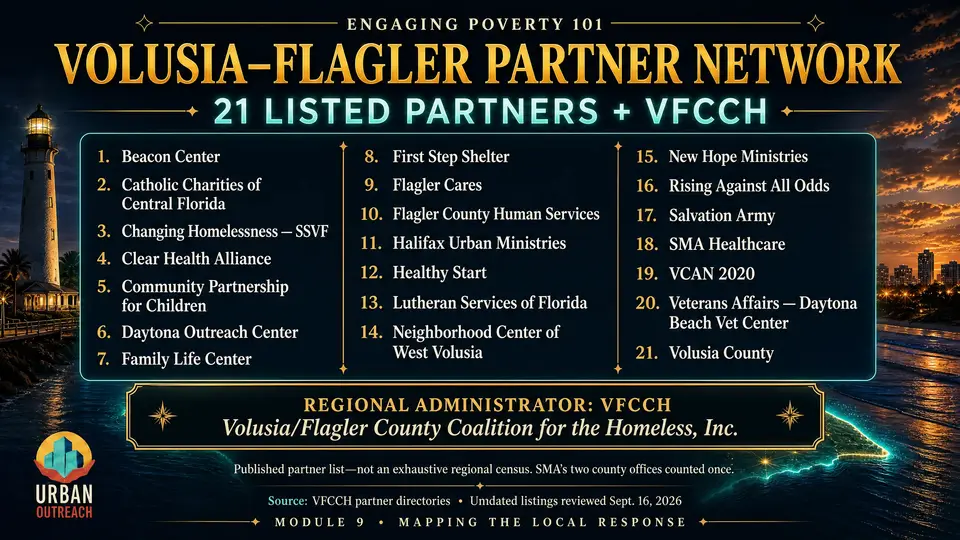
21 listed partners, with VFCCH as regional administrator. Tap a filter or search to narrow the list.
Regional administrator
Volusia/Flagler County Coalition for the Homeless
VFCCH (Volusia/Flagler County Coalition for the Homeless, Inc.) is a separately incorporated nonprofit, formed in 2000, that serves as the FL-504 lead agency, Collaborative Applicant, and HMIS Lead. It coordinates regional planning and funding applications, implements Coordinated Entry, administers HMIS, monitors CoC and ESG recipients, and reports to COHH. Its published partner directories list 21 distinct partner agencies.
Visit website ↗- Domestic violence
Beacon Center
A Volusia victim-services provider offering emergency shelter and case management for survivors of domestic violence and their children; Volusia County identifies it as a CoC service provider.
- Faith-based
Catholic Charities of Central Florida
A diocesan, faith-rooted nonprofit that Volusia County Human Services names, with One Voice, as a partner in its county-supported emergency rent and mortgage assistance program.
- Veterans
Changing Homelessness — Supportive Services for Veteran Families
Its Supportive Services for Veteran Families (SSVF) program is named among the direct street-outreach providers in Volusia County, and Changing Homelessness took part in Flagler County's March 2025 Spring Outreach event.
- Health
Clear Health Alliance
Listed in VFCCH's published partner directories and on the November 2022 HMIS client-consent roster of participating agencies. The research did not document its specific local services.
- Youth & families
Community Partnership for Children
Listed in VFCCH's published partner directories and on the November 2022 HMIS client-consent roster of participating agencies. The research did not document its specific local services.
- Services
Daytona Outreach Center
Listed in VFCCH's published partner directories and on the November 2022 HMIS client-consent roster of participating agencies. The research did not document its specific local services.
- Services
Family Life Center
Supported through Flagler County's outside-agency grants ($92,000 in the FY 2025–26 budget); it also received pandemic-era funds for emergency services, domestic-violence relocation, emergency rent and utilities, and behavioral-health assistance.
- Shelter
First Step Shelter, Inc.
A community shelter for single adults that opened in December 2019, with a separate 24/7 Safe Zone and links to Coordinated Entry, case management, and housing referrals. Its outreach worker is paired with a sheriff's deputy on the Eastern Volusia Homeless Outreach Team.
- Coordination
Flagler Cares
A health-and-human-services coalition that convenes nonprofit, government, and community organizations in Flagler County and serves as a local Coordinated Entry access point. It merged with One Voice for Volusia in July 2024, and its executive director sits on the COHH board.
- Government
Flagler County Human Services
The county department that offers eligible residents rent, utility, first-month-rent, and limited mortgage assistance, and links people to emergency assistance and indigent healthcare.
- Faith-based
Halifax Urban Ministries
A faith-based nonprofit that operates Hope Place for families and young adults, Barracks of Hope veteran transitional housing, food programs, and prevention and rapid re-housing assistance. It is Volusia County's ESG and ESG-RUSH subrecipient.
- Health
Healthy Start
Listed in VFCCH's published partner directories; Healthy Start of Flagler and Volusia Counties appears on the November 2022 HMIS client-consent roster of participating agencies. The research did not document its specific local services.
- Services
Lutheran Services of Florida
Listed in VFCCH's published partner directories. The research did not document its specific local services.
- Shelter
Neighborhood Center of West Volusia
A community nonprofit in West Volusia that operates The Bridge shelter in DeLand for the city and provides emergency, transitional, and permanent supportive housing as well as outreach.
- Services
New Hope Ministries
Listed in VFCCH's published partner directories. The November 2022 HMIS client-consent roster lists New Hope Human Services; the research did not establish whether these are the same organization or document its specific local services.
- Services
Rising Against All Odds
Listed in VFCCH's published partner directories and on the November 2022 HMIS client-consent roster of participating agencies. The research did not document its specific local services.
- Services
Salvation Army
Named in Volusia County's street-outreach and veteran transitional-housing descriptions. The Salvation Army of Daytona Beach and VFCCH carry out rapid re-housing on the county's behalf, and it has appeared in CoC governance and committee roles.
- Health
SMA Healthcare
A behavioral-health provider named in Volusia County's CoC narrative as a specialized partner. VFCCH's directories list separate Volusia and Flagler offices, counted here once.
- Services
VCAN 2020
Listed in VFCCH's published partner directories and, as VCAN2020, on the November 2022 HMIS client-consent roster of participating agencies. The research did not document its specific local services.
- Veterans
Veterans Affairs — Daytona Beach Vet Center
Listed in VFCCH's published partner directories. The VA is named among Volusia County's direct street-outreach providers and specialized partners for veteran supports.
- Government
Volusia County
The county government administers federal and state housing and homelessness grants and its own voucher program, supports major shelter projects through its Homeless Initiatives Fund, and takes part in recurring Coordinated Entry meetings.
Last reviewed September 19, 2026. Notes from the research:
- These are findings retained during course development (research foundation dated September 12, 2026; source checks and corrections September 16–19, 2026), not a new verification. Time-sensitive information should be rechecked before it is presented as current public guidance.
- The partner list reflects VFCCH's published partner directories (seven funded and fifteen non-funded entries; SMA Healthcare's two county offices counted once). It is not an exhaustive census of every agency in the region or a verified current CoC voting-membership roster. The directories are undated, so funding labels should not be treated as a current grant-award audit.
- Hope Place and The Bridge are not counted as separate partners: Hope Place is operated by Halifax Urban Ministries and The Bridge by the Neighborhood Center of West Volusia.
- Appearing on a partner list, a committee, or a funding record does not by itself confer CoC voting rights or prove HMIS use. The VFCCH HMIS page says 13 agencies report data, while the November 2022 consent form listed 22; neither is a verified current user list.
- Shelter figures describe capacity, not available beds. First Step Shelter's website lists 80 residents (excluding its Safe Zone), while the 2025 Housing Inventory Count and Volusia County report 100.
- The current COHH board page is undated and incomplete, so it confirms displayed roles but not the full voting roster.
Go deeper
Read the full transcript
Welcome to Module 9 of Engaging Poverty 101. Bringing It Home: Mapping the Volusia–Flagler Response
Before we begin, let us briefly review the ground we have covered.
Module 1 began with perspective and responsibility. The way we see poverty influences the way we respond to people.
Module 2 confronted stereotypes.
Module 3 expanded the meaning of poverty beyond financial resources.
Module 4 moved from the individual to government programs and showed how policy changes from one administration to the next can affect access to assistance. It also examined benefit cliffs—when an increase in earnings triggers a larger loss of benefits, leaving households worse off as they attempt to move out of poverty.
Module 5, The Conversation, focused on communication. Many of us assume we communicate clearly because we know what we mean we when speak. But the person receiving our message may interpret it very differently because of differences in education, culture, experience, and worldview. Even the right words can be misunderstood when our tone is abrupt, our timing is wrong, or a brief reply is mistaken for indifference. The Shannon–Weaver model describes interference as “noise.” In everyday communication, these habits and differences can have a similar effect: the message we intend is not necessarily the message someone receives. The measure of effective communication is not simply whether we sent a message, but whether we established understanding.
Module 6 addressed affordable housing. People cannot build lasting stability when safe housing remains out of reach. The United States faces a shortage of more than seven million rental homes that are affordable and available to extremely low-income renters.
Module 7 examined the relationship between the Church, parachurch organizations, nonprofits, and government. It established that proximity is not partnership. Organizations often work alongside one another rather than together.
Module 8 studied communities and organizations that put these principles into practice. Houston showed the value of shared data, coordinated access, Housing First, aligned funding, and collective accountability. Santa Clara County demonstrated intervention before housing loss. Rockford showed the power of person-specific information, recurring coordination, and public accountability. The Los Angeles Dream Center illustrated sustained direct service, while Dream.Org demonstrated advocacy and policy change.
Those examples were not templates to copy. They identified principles that could be adapted to other communities.
Volusia and Flagler are not starting from zero. The region already has county and city governments and their agencies, separate housing authorities, shelters, outreach teams, schools, healthcare providers, and specialized services. Faith-rooted nonprofits, volunteers, and community organizations also contribute.
A Continuum of Care, or CoC, is a regional partnership that coordinates homelessness planning, services, and funding. HUD implemented this approach in 1995 to encourage a more coordinated community response.
An important local milestone came in 2000, when the Volusia/Flagler County Coalition for the Homeless, Inc.—known as VFCCH—incorporated to coordinate the regional response and organize funding for local service providers.
In July 2014, the region restructured in response to HUD’s governing-board requirements, separating regional CoC governance from nonprofit administration.
HUD required a representative CoC governing board. VFCCH executive director Lisa Hamilton developed the local election plan. Board president Shelly Campbell was involved, and consultant Patrick Wigmore advised the process. The plan called for CoC members to elect the board. The separate CoC was established in July 2014. COHH gives the regional partnership its own governing voice. It sets CoC direction and reviews results, while VFCCH administers the work.
Local advocates and community leaders were also calling for greater transparency, broader representation, and accountability over funding. HUD supplied the regulatory catalyst amid that local pressure.
VFCCH retained its lead-agency and administrative responsibilities, including its Collaborative Applicant and HMIS Lead roles. Today, the Commission on Homelessness and Housing, or COHH, provides regional CoC governance, including policy, funding priorities, and performance oversight. VFCCH administers key regional functions, including funding…
Beyond changes in governance, local governments and community partners also invested in the facilities and services people turn to for immediate help.
Shelter investments include funding for buildings, renovations, and day-to-day operations. In Volusia County, several facilities expanded the available services. Hope Place opened in 2018. It offers 26 emergency housing rooms and nine transitional apartments for families, plus dormitory space for up to 24 unaccompanied young adults, ages 18 to 24, pursuing education. First Step Shelter opened in December 2019 for single adults. Its website lists capacity for 80 residents, excluding its separate Safe Zone. The Bridge in DeLand opened in September 2020 and provides emergency shelter for up to 30 single adults, along with day services. These figures describe capacity, not currently available spaces.
Shared data was already part of the regional structure by July 2014, when VFCCH retained its role as the Homeless Management Information System, or HMIS, lead. That restructuring did not mark the beginning of the region’s HMIS. Today, VFCCH administers ServicePoint by WellSky, which helps participating providers record needs, track assistance, and support coordination.
Affordable-housing planning predates 2014, including Volusia’s 2010–14 Consolidated Plan. But as housing prices outpaced incomes, Volusia County recognized that its existing programs were not enough. County leaders launched an affordable-housing initiative in 2021, bringing together residents, housing experts, nonprofits, and businesses. That effort produced the 2022–2027 Path Forward plan, a five year plan recommending funding, development, and zoning changes to create and preserve more affordable homes.
It should be noted that the Path Forward five-year plan is a county-government initiative aimed at reducing development costs, improving the approval process, and expanding the land and funding available to create and preserve affordable homes. It is not a program led by Harry Cole or COHH. But the progress of Path Forward has real consequences for organizations working to end homelessness. Although it is Volusia County’s plan, its results matter to agencies serving the wider Volusia–Flagler region. Their ability to move people from homelessness into stable housing depends in part on homes those people can actually afford.
And the shortage is measurable. The University of Florida’s Shimberg Center, in its 2025 report using 2024 Census data, estimated a deficit of 7,461 affordable and available rental homes in Volusia County and 1,883 in Flagler County for households earning no more than 30 percent of their area’s median income. These figures describe a shortage of rental homes for households with very limited incomes—not a count of people experiencing homelessness.
Shelters and outreach teams can help stabilize a crisis, but they still need affordable places for people to move into. When those options are limited, housing placements can slow and shelter stays can lengthen. Families already struggling to pay rent also have fewer affordable alternatives when their circumstances change.
That is why the plan’s results matter beyond the construction industry. For homelessness services, progress depends not simply on building more homes, but on providing homes the people they serve can afford—with rental assistance and support where needed. A home described as affordable for a moderate-income household may still be beyond the reach of someone leaving a shelter, which is why the work is important to understand.
In 2025, the county adopted concrete building incentives. Impact-fee deferrals postpone county charges rather than eliminate them. Fee waivers reduce permit, inspection, and application costs. New affordable accessory dwellings, or smaller secondary homes, can also qualify for deferred impact fees. Expedited review provides a dedicated team to coordinate the development-review process.
The zoning changes provide additional tools. Density bonuses allow more homes per acre in designated urban areas. Flexible site requirements allow adjustments to lot dimensions, setbacks, parking, and other standards. There is also a county approval pathway for affordable housing on commercial or industrial land. A priority overlay directs funding priorities toward housing near jobs, transportation, and services. Conditions apply, and these county provisions do not automatically replace city zoning.
These efforts matter because shelters and service providers need affordable places for people to move into. That is where the county’s housing work must connect with the regional homelessness response. Building homes and helping people access them are related responsibilities, even when different organizations perform the work.
For that connection to work, county government, COHH, and VFCCH need agreement on three commitments.
First, housing opportunities that people leaving homelessness can actually access. Second, clear responsibility for housing, rental assistance, referrals, and services. Third, delivery deadlines and a joint review of results, so delays and obstacles lead to action.
That is the lesson from Houston, Santa Clara, and Rockford: separate organizations can work toward shared results without becoming one agency. COHH does not need to run the county’s housing plan. But the county’s housing work and the CoC’s services need clear commitments to one another—and follow-through.
That brings us back to the regional homelessness response and how responsibility is divided within it. Turning shared commitments into action requires a clear understanding of who sets the CoC’s priorities, who provides oversight, and who carries out the administrative work.
The Volusia–Flagler Continuum of Care is designated FL-504 and covers both counties. It is not a county or city government, a shelter, or a single nonprofit.
Its governing body is the Commission on Homelessness and Housing, commonly called COHH, chaired by Jeanne Rademacher. COHH provides governance and oversight for regional policy, Coordinated Entry standards, funding priorities, performance, and the CoC funding-application process.
The Volusia/Flagler County Coalition for the Homeless—still known by its original acronym, VFCCH—serves as the nonprofit lead and administrative agency. Harry Cole is its Executive Director and Collaborative Applicant representative since the spring of 2023.
As per its original design in 2014 and as previously mentioned, VFCCH still coordinates regional planning and funding applications and administers the Homeless Management Information System, or HMIS. COHH governs the regional Continuum of Care, or CoC. Neither has unlimited authority over local governments, housing authorities, or service providers.
Participating organizations must follow the governance commitments, funding conditions, and HMIS or Coordinated Entry requirements that apply to their programs but they retain responsibility for their own operations.
As with Houston, Santa Clara, and Rockford, the issue with the HMIS is not whether it exists, but whether the software is being properly utilized by participating agencies.
HUD’s January 2025 Point-in-Time count identified 1,083 people experiencing homelessness across Volusia and Flagler Counties. Of that total, 676 people, or 62.4 percent, were unsheltered. The count included children, veterans, young adults, and 182 people experiencing chronic homelessness. Almost one-third of those counted were age 55 or older.
These county profiles broaden the picture, showing the financial pressures that can place housing stability at risk long before someone enters a shelter or sleeps outside.
In Volusia County, the concern extends beyond income alone. Housing costs, food insecurity, and gaps in health coverage can overlap, leaving families with little room for an unexpected expense. The estimate that one in five children faces food insecurity makes that hardship especially clear.
Flagler has a higher median household income than Volusia, but also a higher median rent. About one in six children lives below the poverty line, and roughly one-third of households face housing-cost burdens. Higher countywide income does not mean every household has financial security.
Nor do the pressures mean every struggling household will become homeless. They do explain why the response must extend beyond the people counted on one night. Housing First addresses the need for stable housing among people already experiencing homelessness.
During the 2024–25 school year, Volusia County Schools identified 3,096 students under the education definition of homelessness, while Flagler County identified 393. Those figures include situations such as families staying in motels or living doubled up, so they should not be added to the Point-in-Time count.
The current numbers give us a snapshot of the region’s homelessness. The ten-year chart shows that Volusia–Flagler’s reported count fluctuated from 1,005 people in 2016 to a peak of 1,164 in 2024, before falling to 1,083 in 2025 and 1,015 in 2026. That represents a 6.3 percent decline in the latest year and a 12.8 percent decline from the 2024 peak. The recent reduction matters, although changes in counting and reporting limit exact year-to-year comparisons.
Reviewing the region’s PIT counts alongside those of Florida, the United States, Houston, and Santa Clara gives us another perspective on the data. The table shows that Volusia–Flagler’s 2026 count was about 1 percent higher than its 2016 count—essentially unchanged over the decade. The other areas’ figures cover 2016–2025 because full 2026 totals were not verified. Over that period, Florida’s count fell by 16.9 percent and the Houston region’s fell by 17.5 percent. The national count rose by 35.6 percent, and Santa Clara County’s rose by 64.2 percent. But these figures provide context, not a directly comparable ranking. Volusia–Flagler’s comparison extends through 2026, while the others end in 2025. Population changes, housing markets, and counting methods also differ. Fairly static totals alone do not establish that local efforts have made no difference.
Before we go on, I want to mention some of the largest reported reductions in Florida’s Point-in-Time count since we saw that the statewide count fell substantially from 2016 to 2025, while Volusia–Flagler’s count remained about the same. These communities may offer lessons we can apply closer to home.
On the Treasure Coast, the coalition’s leader attributed the 2023-to-2024 decrease to shifting resources from prevention toward moving people from shelters and streets into housing.
Miami-Dade credits coordinated work among service providers, local governments, and HUD. Its lower 2025 unsheltered count also followed expanded outreach and cold-weather shelter placements. Moving indoors helps, but shelter placement alone does not end homelessness.
In Jacksonville, leaders cautioned that warm weather and people moving into less visible places after camping-law enforcement may have lowered the 2025 unsheltered count. Their weekly data did not show the same decrease.
For Pinellas, St. Johns, and the four-county North Central region, we did not find a verified explanation for the full decline.
The Florida map shows changes from 2016 to 2025, but the explanations we found mostly describe just one recent year. They help explain some of the recent movement, but not the entire long-term decline. We therefore cannot assume that every decrease reflects the same strategy—or that fewer people counted always means more people obtained permanent housing.
That caution reflects a broader lesson: responding to poverty is complex. As we learned in earlier modules, partners can share good intentions yet struggle to communicate across different priorities and procedures. Funding must be weighed against the scale of need, local costs, and restrictions on how it can be used. Government policy can also change funding priorities, as HUD did this year by shifting its CoC funding emphasis away from Housing First toward transitional housing and treatment-focused services. An organization’s experience, training, and staffing may also struggle to keep pace with growing demands. These realities do not remove accountability, but a fair assessment must consider them alongside the results. And these challenges are not confined to Florida—they are part of the larger national picture.
I have included the national map to show that poverty and homelessness reach communities across the country. These comparisons provide context, but understanding progress requires a closer look at both housing outcomes and how people were counted. A lower count, by itself, does not prove that a community’s approach is working.
That brings us back to Volusia–Flagler, where measures beyond the PIT count provide a fuller picture of the region’s progress.
Those measures, reported by HUD for 2022–2024, show uneven progress in helping people leave homelessness and remain housed. Housing-retention results improved, and a slightly lower percentage of people returned to homelessness within six months. However, the average time spent homeless remained longer than in 2022, and the rate of exits from shelter and related programs to permanent housing had not recovered to its 2022 level. The evidence supports some progress—but does not establish that the current response is sufficient.
Approximately six in ten renters in each county were estimated to spend at least 30 percent of their income on rent. About one-third faced severe rent burden. This does not mean every cost-burdened household will become homeless. It does mean that a job loss, medical crisis, rent increase, family disruption, or disaster can quickly push an already strained household into crisis.
Taken together, the evidence supports describing homelessness and housing instability in this region as severe, not minor.
That level of need makes the path to assistance especially important—not just whether services exist, but how reliably people can access the help they need.
Coordinated Entry provides a shared pathway, but local public reporting does not fully show waiting times, accepted referrals, repeated intake, or what happens when no housing opening is available.
The region has also formally adopted Housing First for permanent supportive housing and designated Continuum of Care and Emergency Solutions Grant projects. Housing First reduces barriers by not requiring sobriety, treatment, employment, or another form of readiness before permanent housing. It includes supportive services—not simply a place to live.
As previously mentioned, the current administration is shifting HUD’s Continuum of Care funding priorities away from Housing First and toward transitional housing and treatment-focused services. Those changes remain under legal challenge.
That does not mean housing alone resolves addiction or mental illness. But moving away from an approach with demonstrated housing benefits would be a step backward. The better course is to strengthen treatment and accountability alongside stable housing—not make housing harder to obtain.
For Volusia–Flagler, the practical distinction remains important: FL-504’s policy adoption alone does not establish Houston’s degree of integration or mean every local program follows Housing First.
Beyond policy adoption, the broader response also depends on local governments’ investments in services and coordination
Volusia County also created a Homeless Initiatives Fund, supported major shelter projects, and approved a five-year operating commitment totaling $1.3 million to First Step Shelter. The county administers housing and homelessness grants and participates in recurring Coordinated Entry meetings. Daytona Beach has supported First Step Shelter. Mayor Derrick Henry also chairs the shelter’s board and has supported fundraising for its work. This is meaningful municipal leadership,
but funding a shelter is not the same as regional coordination. In the public records reviewed we could not verify a direct financial contribution from Daytona Beach to VFCCH in recent years. Historical reporting, however, shows that Daytona Beach contributed up to $17,000 annually to VFCCH through the city’s federal Community Development Block Grant allocation. That support continued until a funding cut in fall 2013. Current contributions to VFCCH from Daytona Beach, DeLand, Palm Coast, Ormond Beach, or the other local municipalities reviewed could not be verified. That finding concerns the public records reviewed; it does not mean no support exists. Local governments should clarify how they support regional coordination, separately from their funding of shelters and other programs. Where that support is absent, they should consider a contribution tied to clear responsibilities and measurable results. Regional coordination benefits cities, and that work requires resources.
Unlike Florida counties such as Orange and Miami-Dade, Volusia County does not have a county mayor.
It operates under a council–manager system, with Jeff Brower, its’ elected County Council Chair, while each municipality has its own government. Flagler County and its municipalities have separate governing bodies as well.
With responsibilities spread across several governments, the important issue is how separate commitments translate into shared goals and public accountability. County and city leadership provide opportunities for regional cooperation, but holding those offices does not establish a coordinated partnership. The test is whether their governments agree on responsibilities, report progress, and follow through.
Rockford linked city leadership to monthly public progress reviews, illustrating accountability beyond support for an individual facility. Volusia–Flagler also has recurring COHH reviews of funding and performance, with public committee meetings and posted minutes. What we have not verified is a comparable monthly forum where elected leaders jointly report on regional homelessness results.
The public record shows multiple local commitments, but the records reviewed do not establish one two-county political agreement connecting shared reduction targets, named implementation owners, aligned budgets, and routine public progress reports. That is a gap in what we can verify—not proof that coordination is absent.
The same distinction applies to stakeholder buy-in. Participation by agencies, governments, and community organizations is documented, but participation alone does not demonstrate agreement across the region on goals, responsibilities, and follow-through.
The reviewed records do not verify a named local congregation as a current formal voting CoC member or HMIS participant. The Salvation Army has appeared in governance and committee roles, and Halifax Urban Ministries has received public funding for housing and homelessness work.
HUM’s public funding is one part of a broader investment in the region’s response. County and city programs, regional CoC grants, and other public and private resources support different parts of that work. Meaningful resources are being invested, but the public records reviewed do not bring them together into one reliable total for homelessness spending across Volusia and Flagler.
HUD’s clearest regional figure is the $3,023,566 fiscal year 2024 FL-504 award across housing, services, planning, data, and coordinated-entry projects.
Volusia separately administers federal and state housing programs, vouchers, disaster resources, and local shelter commitments. Flagler budgets housing assistance, emergency rent and utility help, cold-weather shelter support, and outside-agency funding. Palm Coast operates a separate federal community-development program.
Those numbers cannot simply be added. Some are budgets, some are awards, some are expenditures, some are one-time disaster funds, and some support affordable housing more broadly rather than homelessness alone.
VFCCH’s finances are clearer to see than the region’s combined spending. Its audited statements for the year ending June 2025 report about $3.56 million in support and revenue. Government grants provided nearly 92 percent. United Way, rental income, donated goods and services, and other income and contributions made up the rest. This includes noncash support, not just money received. The important point is that VFCCH depends heavily on public funding—but this is its revenue, not the entire region’s homelessness budget since
VFCCH’s budget is one part of the regional response—not the whole. Other organizations receive funding separately, and some money passes between agencies.
As for how VFCCH spends its funds, it reported about $3.53 million in expenses during that same year. Nearly 39 percent went to grants for partner agencies, while personnel accounted for just under 30 percent. Client services represented 12 percent. The rest covered property, office expenses, professional fees, software and other costs. Personnel includes wages, payroll taxes and benefits for program work as well as administration. Reported expenses also include some noncash items. These figures explain how VFCCH uses resources; they do not, by themselves, establish whether the regional response is achieving better housing outcomes.
Many individual funding amounts are known for the region , but the public picture of total spending and its results remains incomplete. That makes it harder to assess whether resources match needs and produce lasting results.
The largest accountability gap is the absence of one public picture connecting need, funding, access, referrals, housing placements, housing retention, and geography—and showing whether different populations have fair access to assistance and opportunities for lasting housing.
As we close Module 9, Volusia and Flagler counties have a foundation to build on: formal leadership, shared data, coordinated entry, and a network of agencies providing different kinds of help. These are important strengths, even as gaps in public reporting leave parts of the picture unclear. Lasting progress depends on more than policies or software—it depends on people working together, available housing, and sustained support.
We have brought the conversation home, connecting what we learned elsewhere to the response in our own community. Behind every referral, program, and funding decision is a person who needs somewhere to turn. In Module 10, we’ll get to know the agencies doing this work more closely—and explore where you can find your place alongside them.
As we have learned, shared software does not automatically produce a complete picture. Reliable reporting also requires common definitions, current records, trained staff, and follow-through. That means the only people able to truly assess the Volusia–Flagler region are those involved with the work. Therefore, we invite you, the viewer, to assess the regional response using each of our twelve criteria under two broad categories, Leadership, Data & Access as well as Services, Housing and Results.
If you have a role in the work of Volusia/Flagler county, please take the time to score each criterion from zero to ten. Zero means not in place; five means partly working; ten means sustained, measured, and accountable. Use scores between those points as appropriate. Mark unknown or N/A when evidence is insufficient—not zero.
We will begin with the issue of Leadership, Data & Access
Governance and accountability: Are responsibilities clear, with authority to resolve problems and follow through?
Political leadership and priority: Do elected leaders sustain this priority through funding targets, and action?
Stakeholder alignment and buy-in: Do government, nonprofits, faith, business, and healthcare partners share goals and responsibilities? OR Are they competing for funding in ways that put their own organizational priorities ahead of shared community goals?
Lived experience and equity: Do affected residents shape decisions, and do we investigate differences in housing outcomes and address avoidable barriers?
Data, HMIS, and measurement: Are records current, reliable, and shared appropriately, with coverage gaps identified?
Access, Coordinated Entry, and referrals: Can people access help and complete referrals without repeatedly starting over?
Now let’s assess the Services, Housing & Results of our region.
Service continuum and coverage: Are prevention, outreach, shelter, health, and specialized services sufficient and accessible?
Housing pathways and supply: Can people access appropriate permanent housing and the support to keep it?
Prevention and inflow reduction: Are avoidable housing losses prevented, and new entries into homelessness tracked?
Funding sufficiency and transparency: Is funding adequate, and can spending be traced to services and results?
Outcomes and continuous improvement: Are housing outcomes improving, with setbacks used to change practice?
Public communication and accountability: Can the public see results, spending, responsibilities, and corrective action?
Once you have completed your ratings independently, arrange a time with relevant partners and people with lived experience to compare the evidence, discuss differences, and identify missing information.
And remember, the goal is not a flattering score – that won’t help the region become the best it can be. Strong communication and shared understanding will lead to progress and a more efficient system.
Volusia and Flagler have built important parts of a regional response. The next stage requires broader shared ownership, stronger prevention, more attainable housing, clearer coordinated-entry results, and a public line of sight from dollars and decisions to resident access and lasting housing stability.
The lesson from the first eight modules now becomes local. Perspective must overcome stereotypes. Stability must be understood as more than income. Systems must remain connected to relationships. Communication must lead to completed handoffs. Affordable housing must be treated as essential infrastructure. Churches, nonprofits, government, business, healthcare, and community partners must contribute through clear roles rather than competing claims. Proven ideas from other communities must be adapted carefully rather than copied blindly.
Module 9 brought the lessons of this series home to Volusia and Flagler. We have seen valuable work, committed partners, and opportunities to strengthen the response. Understanding that picture gives us a better starting point for meaningful involvement.
Module 10, The Role You Can Play, turns from understanding the system to finding your place within it. We will explore practical ways to contribute your time, skills, relationships, or resources in partnership with people already doing the work. The goal is to choose a useful role, prepare well, and follow through.
Your community may already be doing meaningful work. But without a structured assessment, blind spots can remain hidden—and stand in the way of your goals.
Urban Outreach can help your city or county take a deeper look at its response to poverty and homelessness. Together, we can identify strengths, uncover gaps, and clarify practical next steps.
Let’s build on the work you’re already doing. Contact us at the email on your screen to discuss scope and pricing.
Sources named in this module
- HUD, FY 2024 Continuum of Care Competition Awards Report
- HUD, 2025 Continuum of Care Homeless Populations and Subpopulations: FL-504
- VFCCH, 2026 Point in Time Count and Housing Inventory Report: Volusia and Flagler Counties
- HUD, FL-504 CoC Performance Profile, 2024: System Performance Measures
- HUD, 2025 AHAR Part 1 and 2007–2025 Point-in-Time Estimates by CoC
- University of Florida Shimberg Center, 2025 Annual Report: Affordable and Available Rental Housing Supply
- Florida Department of Education, 2024–25 Homeless Student Count
- Volusia/Flagler County Coalition for the Homeless, Coalition History
- Commission on Homelessness and Housing, Governance Documents (Charter, MOUs, Coordinated Entry Policies)
- Commission on Homelessness and Housing, Board Members
- Volusia/Flagler County Coalition for the Homeless, HMIS Overview
- Volusia County, The Path Forward: Strategies for Success, 2022–2027
- Volusia County Ordinance 2025-01: Affordable Housing Zoning Provisions
- County of Volusia, Draft Consolidated Annual Performance and Evaluation Report FY 2024/25
- First Step Shelter, Who We Are
- City of DeLand, The Bridge Homeless Shelter Public Notice
- Halifax Urban Ministries, Locations and Programs
- Flagler County Board of County Commissioners, Adopted Budget FY 2025–26
- VFCCH, Funded Partners
- VFCCH, Non-Funded (Participating) Partners